Every face ratio Glowometry measures
Glowometry uses facial landmarks to calculate 45 front-facing measurements and 40 side-profile measurements. This guide explains what each ratio, angle, and offset describes, how the values are derived, and what can affect a photo-based result.
What the result means
These ratios, angles and offsets quantify the facial relationships that influence balance, harmony, sexual dimorphism and perceived attractiveness.
Glowometry interprets each value through facial-aesthetics research, attractive-cohort data and the rest of the face. Where a preferred range is supported, the report states it directly.
Ratios compare one distance with another, and angles are reported in degrees. Profile offsets marked % are relative to vertical hairline-to-chin height. E-line offsets and chin recession use directional labels. Values marked px are uncalibrated image distances, not millimetres.
Front-facing measurements
Use a level, front-facing photo for measurements across facial width, height, thirds, eyes, nose, mouth, jaw, chin, and neck.
45 measurements

Proportions and jaw shape
These measurements describe the overall frame, facial thirds, lower-face width, and the shape transition from cheekbones to jaw and chin.
- Facial Width-to-Height Ratio (fWHR)
- Compares cheekbone width with the central face height from the nose bridge to the upper lip.
- Total Face Height To Width Ratio
- Compares hairline-to-chin height with cheekbone width to describe the overall facial frame.
- Bitemporal Width Ratio
- Compares temple width with cheekbone width to describe the taper or straightness of the upper face.
- Bigonial Width Ratio
- Compares jaw-corner width with cheekbone width to describe lower-face taper.
- Chin Width Ratio
- Compares the front width of the chin with cheekbone width to show how the jaw finishes at the centre.
- Mid Face Ratio
- Compares interpupillary distance with the vertical distance from the eye midpoint to the upper lip.
- Frontal Jaw Angle
- Measures the angle formed by the left and right mandibular sides in the front view.
- Ipsilateral Alar Angle
- Measures the angle spanning the lateral eye corners and the nose base, describing the central face triangle.
- Difference Between Ipsilateral Angle - Frontal Jaw Angle
- Compares the central face triangle angle with the frontal jaw angle to show how similarly the upper and lower face taper.
- Upper Third Ratio
- Reports the hairline-to-nasion segment as a percentage of total face height.
- Middle Third Ratio
- Reports the nasion-to-subnasale segment as a percentage of total face height.
- Lower Third Ratio
- Reports the subnasale-to-chin segment as a percentage of total face height.
- Neck Width Ratio
- Compares manually placed neck width with posterior jaw width. Neck points are optional and may need user placement.
Eyes, nose, and mouth relationships
These ratios describe spacing and proportions across the eyes and central face. They are sensitive to gaze, expression, camera level, lighting, and visible eyelid or iris landmarks.
- Chin To Philtrum Ratio
- Compares the lip-to-chin segment with the subnasale-to-upper-lip philtrum segment.
- Mouth To Nose Width Ratio
- Compares mouth width with nose-base width.
- Eye To Mouth Angle
- Measures the angle formed by the eye span and the eye-to-mouth height.
- Canthal Tilt
- Measures the average slope from the inner to outer eye corners after correcting for head roll.
- Eyebrow Tilt
- The average direction of the brow centrelines from inner brow toward the arch.
- Brow Length
- Full brow width projected onto the eye line.
- Brow Arch Angle
- The internal angle at each brow peak.
- Brow Peak Position Ratio
- Brow peak position along the full brow width.
- Pupil-to-Brow Distance
- Vertical distance from the pupil centre to the lower brow.
- Pupil-to-Brow-Peak Distance
- Vertical height of the brow peak above the pupil.
- Brow-to-Upper-Eyelid Distance
- The average distance from the upper eyelids to the lower brows.
- Medial Canthal Length
- The length of the small wedge at each inner eye corner.
- Eye Aspect Ratio
- Compares visible eye-opening height with eye width to describe a longer, narrower opening or a more vertically open one.
- Eye Spacing Ratio
- Compares interpupillary distance with cheekbone width.
- Intercanthal To Eye Width Ratio
- Compares the inner-eye gap with the average width of the two eyes.
- Nose To Intercanthal Width Ratio
- Compares nose-base width with the distance between the inner eye corners.
- Mouth To Interpupillary Width Ratio
- Compares mouth width with the distance between the iris centres.
- Eye Width To Face Width Ratio
- Compares average eye width with cheekbone width.
- Nose To Face Width Ratio
- Compares nose-base width with cheekbone width.
- Lower to Upper Lip Ratio
- Compares lower-lip height with upper-lip height using the visible lip landmarks.
- Cupid’s Bow Depth
- Estimated depth of the central upper-lip dip.
- Cupid’s Bow Angle
- The angle at the central upper-lip dip between the two Cupid’s bow peaks.
- Nose Height To Width Ratio
- Compares nasion-to-subnasale height with nose-base width.
- Philtrum To Lower Third Ratio
- Compares philtrum height with the full subnasale-to-chin lower third.
- Ear Protrusion Angle
- How far the ears extend outward in the front view.
- Ear Protrusion Ratio
- Ear extension beyond the cheeks, relative to face width.
Side-profile measurements
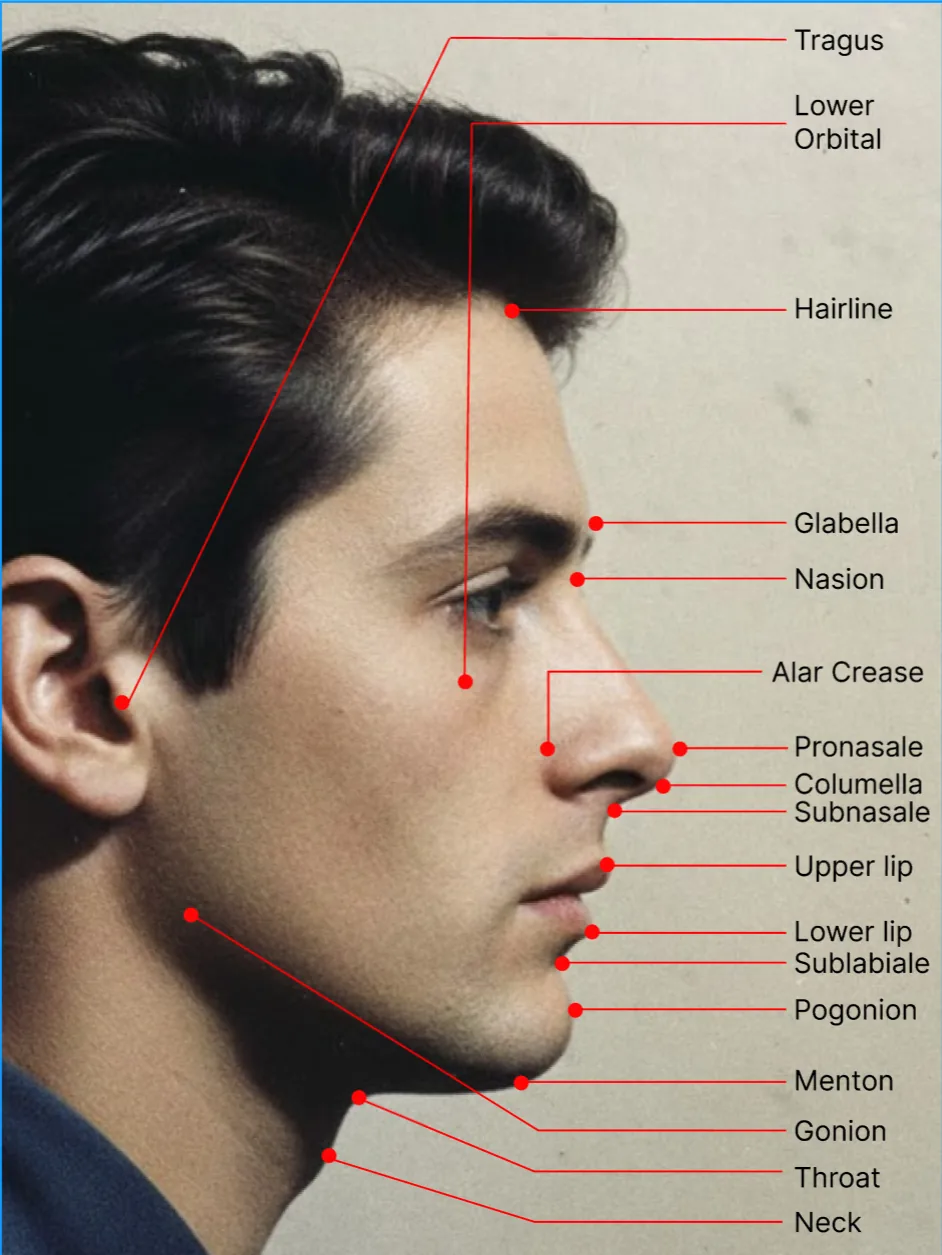
These measurements use a side-profile image to describe the relationships among the forehead, nose, lips, chin, jaw, throat, and neck. Profile values depend strongly on head position and landmark placement.
40 measurements
Angles, projection, and contour
These measurements describe profile curvature, facial planes, feature projection, lip and chin relationships, and the transition from jaw to neck.
- Facial Convexity Angle
- Measures the angle through the glabella, subnasale, and pogonion to describe overall profile curvature.
- Nasofrontal Angle
- Measures the forehead-to-nasal-bridge transition through the glabella, nasion, and pronasale.
- Nasal Tip Angle
- Measures the angle formed by the nasal bridge, tip, and columella.
- Columella Size
- Measures the subnasale-to-columella segment as a percentage of nose-root-to-tip length.
- Nasolabial Angle
- Measures the angle between the underside of the nose and the upper-lip line.
- Mentolabial Angle
- Measures the fold and transition between the lower lip, sublabiale, and chin.
- Facial Plane Angle
- Compares the nasion-to-pogonion facial plane with the Frankfurt horizontal reference.
- Mandibular Plane Angle
- Compares the mandibular border with the Frankfurt horizontal reference to describe jaw slope.
- Recession to Frankfurt Plane
- Places the chin relative to the Frankfurt reference line to describe forward or backward profile position.
- Z Angle
- Compares the upper and lower lip positions with chin projection in the side view.
- Submental Angle
- Measures the turn from the facial and chin region into the underside of the jaw.
- Cervicomental Angle
- Measures the transition from the underside of the chin into the neck.
- Jaw Length to Face Height Ratio
- Compares the jaw-corner-to-chin span with the facial reference height.
- Nasal Projection Ratio
- Compares nose-tip projection with the supporting nose-base geometry.
- Chin to Lip Step Depth
- Measures horizontal separation between the fold below the lower lip and the forward chin in source-image pixels.
- Nose Length to Face Height Ratio
- Compares profile nose length with the reference face height.
- Upper to Lower Face Ratio
- Compares the upper facial segment with the jaw and chin segment in profile.
- Upper Lip to E-Line Offset
- Reports the upper lip position relative to the line from the nose to the chin.
- Lower Lip to E-Line Offset
- Reports the lower lip position relative to the line from the nose to the chin.
- Upper Forehead Slope
- Measures the angle at the brow ridge between the hairline and a forehead contour point.
- Browridge Inclination Angle
- Measures the hairline-to-brow-ridge line against vertical to describe forehead lean.
- Facial Convexity (Nasion)
- Measures profile curvature through the nasal root, nose base, and forward chin, with convex or concave direction.
- Total Facial Convexity
- Measures profile curvature through the brow ridge, nose tip, and forward chin, including nasal projection.
- Orbital Vector
- Compares the horizontal position of the lower orbital rim with the front of the eye, as a percentage of facial height.
- Facial Depth to Height Ratio
- Compares ear-to-nose-base depth with the distance from the nasal root to the fold below the lower lip.
- Anterior Facial Depth
- Measures the angle at the nasal-wing base between the ear reference and lower eyelid. This is an angle, not a distance.
- Interior Midface Projection Angle
- Measures the nasal-wing-base-to-outer-eye-corner line against horizontal.
- Nasofacial Angle
- Compares the nasal-root-to-tip direction with the nasal-root-to-chin facial line.
- Nasomental Angle
- Measures the angle at the nose tip between the nasal root and forward chin.
- Profile Nasal Width to Height Ratio
- Compares horizontal nose-tip reach from the nasal-wing base with vertical eye-to-tip separation. This is not frontal nostril width.
- Nose Tip Rotation Angle
- Measures the columella direction relative to the porion-to-orbital-rim reference.
- Frankfort-Tip Angle
- Measures the nose-base-to-tip direction relative to the porion-to-orbital-rim reference.
- Upper Lip to S-Line Offset
- Reports upper-lip position relative to the nose-base/tip-midpoint-to-chin line, as a percentage of facial height.
- Lower Lip to S-Line Offset
- Reports lower-lip position relative to the nose-base/tip-midpoint-to-chin line, as a percentage of facial height.
- Upper Lip to Burstone-Line Offset
- Reports upper-lip position relative to the nose-base-to-forward-chin line, as a percentage of facial height.
- Lower Lip to Burstone-Line Offset
- Reports lower-lip position relative to the nose-base-to-forward-chin line, as a percentage of facial height.
- Holdaway H-Line Offset
- Reports lower-lip position relative to the upper-lip-to-chin line, as a percentage of facial height. This is an offset, not the H-angle.
- Side-Profile Gonial Angle
- Measures the angle where the extended ascending and lower jaw-border lines meet.
- Ramus to Mandible Ratio
- Compares the ear-to-constructed-jaw-corner length with the constructed lower jaw segment ending beneath the forward chin.
- Gonion to Mouth-Line Offset
- Reports how far the constructed jaw corner sits below or above mouth-corner level, as a percentage of facial height.
How does it work
- 01
A front-facing photo is analysed for landmarks around the hairline, temples, cheekbones, jaw, eyes, nose, mouth, chin, and optional neck points.
- 02
A side-profile photo uses landmarks around the ear, orbital rim, forehead, nose, lips, chin, jaw, throat, and neck.
- 03
Glowometry connects the required landmarks, measures distances or angles, and combines them into named ratios. The supporting landmarks and lines remain reviewable in the analysis report.
- 04
Photo angle, head rotation, expression, lighting, hair, image quality, and landmark placement can change a result. A missing or degenerate landmark makes the affected measurement unavailable rather than inventing a value.
Views you may see
- Front-facing
- Ratios and angles describing facial width, height, thirds, eye relationships, nose and mouth proportions, jaw shape, and neck width from a front-facing photo.
- Side profile
- Angles, ratios, and offsets describing facial convexity, nose projection, lip and chin relationships, jaw slope, and the jaw-to-neck contour from a side-profile photo.
For a clearer result
- Use a clear, well-lit front-facing photo for front measurements and a separate side-profile photo for profile measurements.
- Keep the camera close to face height and avoid wide-angle photos taken very close to the face.
- Use a relaxed expression and neutral gaze. Squinting, smiling, looking up, or turning the head changes landmark geometry.
- Keep hair away from the hairline, temples, cheekbones, jaw, and chin when possible. Review or adjust landmarks if the photo makes a point uncertain.
Ready to analyse your facial structure?
Upload a photo and explore your personalised analysis.