Brow-to-upper-eyelid distance
Brow-to-upper-eyelid distance describes the separation between the central upper eyelid margin and the brow above it. A smaller distance creates a more compact eye region; a larger distance leaves more space between the eye opening and the brow. The reported value averages both sides.
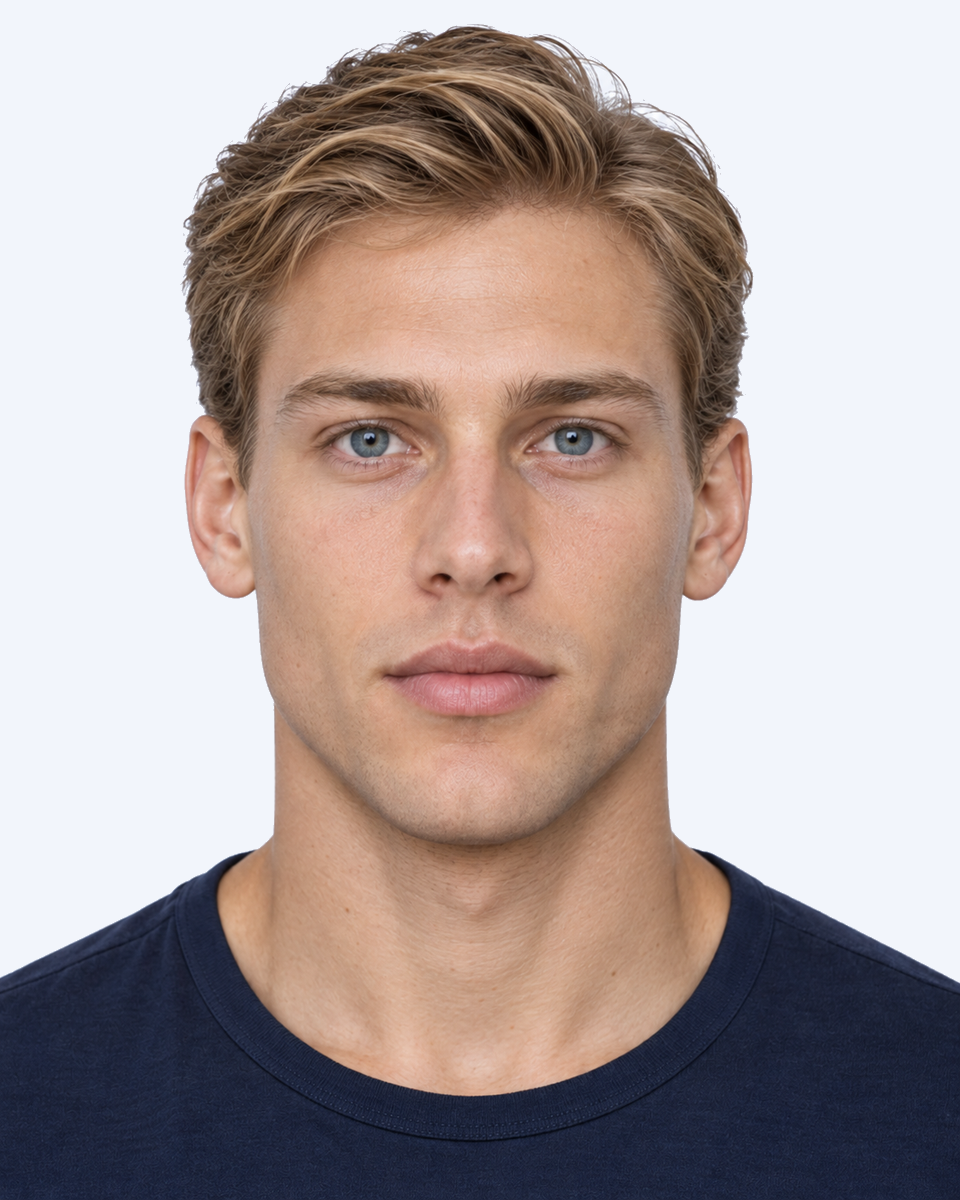
8.94 mm
Central upper eyelid to brow landmarks
the average vertical gap between the upper eyelid margins and the marked brow contours.
UL and UR mark the central upper eyelid margins; BL and BR show where the upward measurement lines meet the brow landmark contours.
Smaller and larger gaps
Compare smaller and larger brow-to-eyelid gaps with the original portrait in the centre.
Brow-to-eyelid separation
Brow height and the space above the eye
A smaller gap places the brow closer to the eye opening. A larger gap creates more separation above the eye. Brow shape, thickness and eyelid position also contribute to the appearance.
This distance is separate from visible upper eyelid skin, which runs from the lash line to the crease or overlying fold. A compact brow gap can occur with either visible or hooded eyelids.
Closer brows and greater separation
At a smaller distance, the brow and upper eyelid form a closely spaced pair of contours. A thick, horizontal brow can make that region look especially compact. The gap describes their separation at the centre of the eye; the brow tail may still rise farther away toward the temple.
As the distance increases, more space appears between the eye opening and the brow. The upper lid may show a crease, a fold or a smooth area of skin within that space. The same distance can therefore accompany different amounts of visible eyelid skin.
Brow thickness, arch and eyelid shape
The lower border of a thick brow can sit close to the eye while its upper border extends much higher. A thinner brow at the same landmark height may leave a lighter, more open impression. Hair density also changes how strongly the brow frames the opening.
An arched brow creates a changing distance across its length. Measuring above the central eyelid captures one part of that curve, rather than the highest point of the arch or the end of the tail. Brow slope and peak position help explain the rest of its shape.
The eyelid supplies the other endpoint. A naturally taller eye opening brings its upper margin closer to a fixed brow. A hooded fold can conceal the crease without changing the brow-to-margin distance in the same way.
Brow-to-eye distance and male attractiveness
Pietruski and Majak measured 300 White professional male models, approximately ages 18–39. The vertical distance from the upper lid margin apex to the inferior brow edge averaged 5.01 ± 2.14 mm. They described relatively broad, flat brows positioned close to the eyes.
The sample was selected through modelling agencies. These measurements describe that group; the study did not experimentally establish a distance that maximises attractiveness.
The reference interval
The 7.4–11.6 mm reference is a provisional Glowometry comparison range. It uses points within the brow rather than its lowest hair edge, so it is higher than the published lower-edge distance. The study did not validate this adjusted range.
Reading your result
The result averages both eyes. A similar average can come from matching gaps or different distances on each side. Compare the individual lines in photographs taken with a relaxed forehead and naturally open eyes.
Keep the endpoints consistent
The lower endpoint sits at the centre of the upper eyelid margin, where the lid meets the eye opening. The crease and the tips of the lashes are outside the measurement. Keep the brow points at a consistent height within the brow when comparing photographs.
How we measure it
We measure the vertical gap from each central upper eyelid margin to the marked brow contour, then average both sides. Millimetre values are estimates from the photograph.
- 1
Mark the central upper eyelid margin on each eye and retain the app’s lower-brow landmark contour.
- 2
Measure vertically from each upper eyelid point to the marked brow contour.
- 3
Average the two distances.
Getting a clear photograph
- Look straight ahead with naturally open eyes and a relaxed forehead.
- Keep the head upright and camera near eye height; head pitch changes the apparent eye area.
- Avoid squinting, raising the eyebrows or using a partial-blink image.
- Brow grooming, makeup and hair thickness can change the apparent brow boundary.
- Use similar camera distances when comparing photographs.
Check the marked points
- Confirm each central upper-lid point lies on the lid margin, not the crease.
- Review the brow contour points using the same app convention on both sides.
- Keep genuine left-right differences; do not move points to force symmetry.
Measure your brow-to-upper-eyelid distance
Upload a front-facing photograph to see your result and review the marked points.
Sources
- 1 The Male Eyebrow and Eyelid: An Anthropometric Analysis of White Professional Models
Reports upper-eyelid-to-brow-edge distance in 300 White male models.
- 2 Glowometry front-view measurement protocol
Measurement definitions and reference intervals.
Related guides
Canthal tilt
Canthal tilt measures the slope between the inner and outer eye corners.
Eye aspect ratio
Eye-opening height relative to width, and the difference between roundness and size.
Eye width-to-face width ratio
Eye width relative to the cheeks, and how opening height changes the appearance of eye size.