Midface ratio
Midface ratio compares pupil spacing with the vertical distance from the midpoint between the pupils to the top of the upper lip. A higher ratio describes a wider or shorter central arrangement; a lower ratio describes a narrower or taller one.
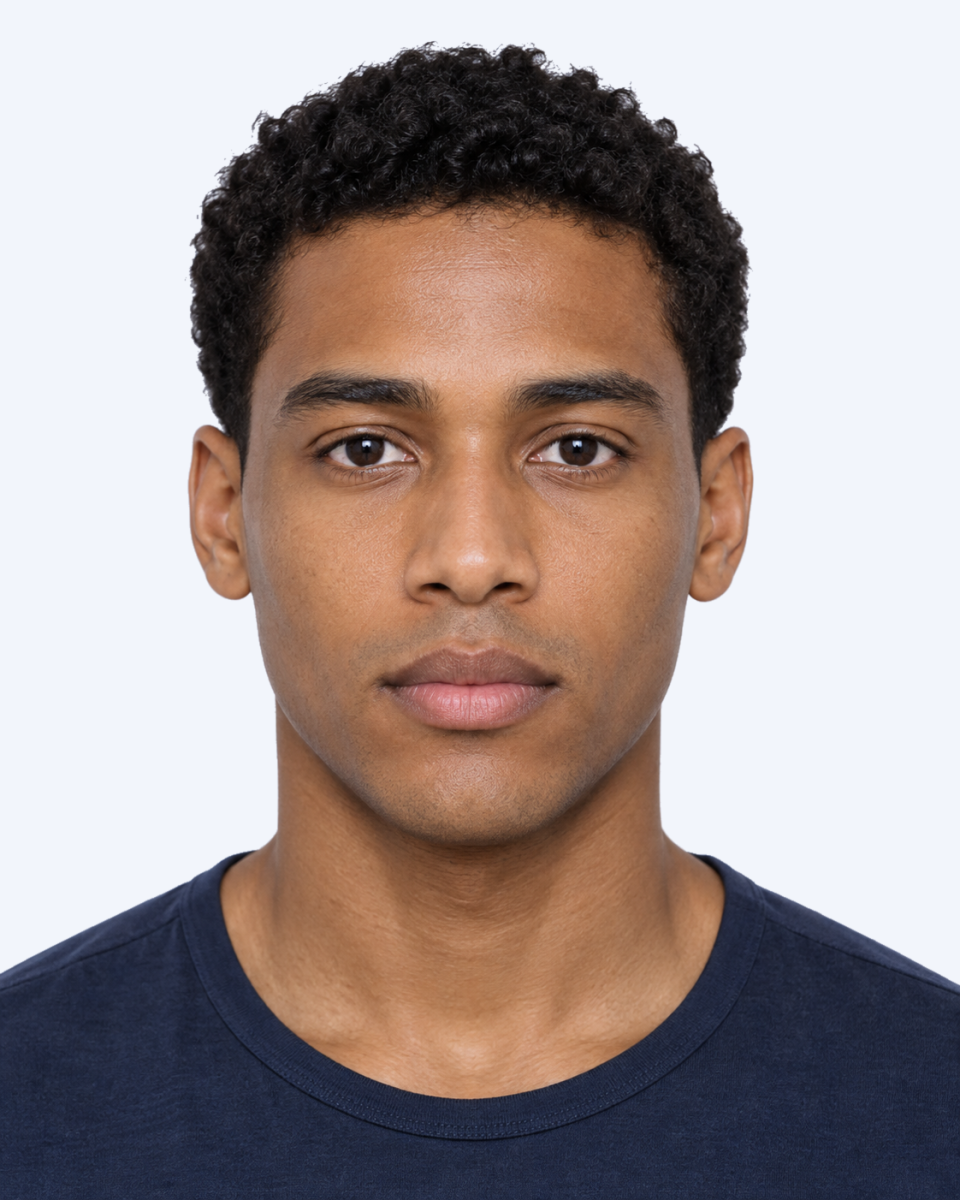
1.05 ratio
Midface ratio
pupil distance divided by pupil-midpoint-to-upper-lip height.
The marked points show where we measure midface ratio.
What different ratios look like
Compare the examples on either side with the original portrait in the centre.
Baseline comparison
The space between the eyes and upper lip
The pupils define a horizontal span across the centre of the face, while the upper lip marks the bottom of the measured region. Comparing those distances describes the proportions around the nose and philtrum. Near a ratio of one, pupil spacing and eye-to-lip height are similar.
The features inside this region can occupy its space differently. A tall nose followed by a short philtrum may place the upper lip at the same level as a shorter nose followed by a long philtrum. Their midface ratios can match even though the spacing immediately above the mouth looks different.
A longer centre or closer pupils
A low ratio can reflect more height between the eyes and upper lip. With pupil spacing unchanged, a lower upper-lip position extends the measured region vertically. A tall nasal region or a long philtrum may contribute to that distance, so looking at each helps locate where the extra height occurs.
Closer pupils also lower the ratio, even when the vertical distance is ordinary. The centre then looks narrow rather than particularly long. This arrangement can sit within narrow cheeks or inside a much broader face, where the eyes may appear concentrated towards the middle.
When limited pupil spacing accompanies greater eye-to-lip height, both dimensions contribute to an elongated impression. Broad cheekbones can still surround that narrow interior. A face can therefore look wide across the cheeks and long between the eyes and mouth at the same time.
A shorter centre or wider pupil spacing
Wider pupil spacing raises the ratio by adding horizontal span. That spacing may come from long eye openings, a larger gap between them, or a combination. Long eyes around a modest gap fill more of the region than short eyes separated by a wide gap, despite potentially similar pupil distances.
A shorter eye-to-lip interval raises the ratio by bringing the upper lip closer to the eye line. The centre may look compact without the eyes being widely spaced. This compactness can occur within a short face, or beneath a tall forehead and above a long chin. The ratio describes the interior arrangement while those surrounding regions determine the full facial height.
Locating the width and height
Pupil-to-face width helps assess how widely the eyes sit within the cheeks. If it is low alongside a low midface ratio, limited pupil spacing may contribute to both results. The eye openings and inner-corner gap then show whether that limited span comes from smaller eyes or closer placement.
The middle third covers the nasal root to the nasal base, so it helps locate nasal height within the larger eye-to-lip interval. A large middle-third share can accompany a near-square midface ratio when pupil spacing is also broad. Conversely, a short nasal region followed by a long philtrum can leave substantial height between the eyes and upper lip.
Cheekbone width supplies another comparison through fWHR. Broad cheeks can raise fWHR while close pupils keep the midface ratio low. This difference describes a broad outer face around a narrow central arrangement, rather than conflicting readings of the same shape.
Eye-to-mouth angle uses the pupil span too, but ends at the closed-mouth seam instead of the top of the upper lip. Upper-lip height separates those endpoints. A taller visible upper lip can therefore deepen the eye-to-mouth triangle without an equivalent change in the midface measurement.
Feature placement and attractiveness
Pallett, Link and Lee changed eye and mouth spacing within the same faces and found that the edits affected attractiveness ratings.
Their experiment expressed spacing relative to facial width and height rather than testing this exact midface ratio. The 0.97–1.02 reference describes a near-square relationship, but its endpoints are not established preference boundaries.
Growth and changes around the upper lip
Eye-region dimensions and central facial height develop at different rates. As the face matures, the distance down to the upper lip can increase more than pupil spacing, lowering the ratio. Velemínská and colleagues also associated larger adult faces with greater elongation, so facial size may accompany differences in shape.
In adulthood, changes around the upper lip can affect the lower endpoint or make the interval appear longer. Sforza and colleagues documented age-related changes in visible lip height. Nunes and Bran found that removing philtral definition made the skin above the lip look longer in edited portraits, even without lengthening it.
How we measure it
We divide the distance between the pupils by the height from their midpoint to the top of the upper lip.
- 1
Locate the centre of each pupil and measure the distance between them.
- 2
Measure from the midpoint between the pupils to the top edge of the upper lip.
- 3
Divide pupil spacing by this eye-to-lip height.
Getting a clear photograph
- Use a straight-on portrait with the camera near eye height and the head upright.
- Avoid close wide-angle selfies; perspective changes central features relative to the facial outline.
- Smiling lifts the upper lip and shortens the eye-to-lip distance.
- Looking up or down changes the apparent distance between the pupils and upper lip.
Check the marked points
- Check that both pupil points sit at the centres of the pupils.
- Place the upper-lip point on its top edge, not on the seam between the lips.
- Retake with relaxed closed lips and eyes naturally open.
Measure your midface ratio
Upload a front-facing photograph to see your result and review the marked points.
Sources
- 1 New “golden” ratios for facial beauty
Within-face experiments tested eye and mouth spacing. Published percentages use specific face-height and inner-ear-width endpoints, not every app ratio.
- 2 The role of holistic processing in judgments of facial attractiveness
Composite-face experiments show that the attractiveness of one region is influenced by the rest of an aligned face.
- 3 Craniofacial growth: a three-dimensional soft-tissue study from 6 years to adulthood
Documents unequal growth of facial regions, including greater proportional growth of the lower third.
- 4 Surface facial modelling and allometry in relation to sexual dimorphism
Relates facial size to shape and sex-related morphology in young Central European adults; larger faces were more elongated.
- 5 Age- and sex-related changes in three-dimensional lip morphology
Documents age-related changes in lip size and visible vermilion, including declining vermilion-height-to-mouth-width ratios with age.
- 6 The Impact of the Philtrum on Facial Attractiveness, Perioral Proportions, and Perceptions of Facial Aging
Manipulating philtral contour changed perceived upper-lip length, age and attractiveness without establishing an optimal measured length.
- 7 Glowometry front-view measurement protocol
Explains how the measurement is calculated and which reference range is used.
- 8 Reliability of measurements taken from facial photographs
Documents the effect of photographic setup and landmark placement on facial measurements.
- 9 Focal length affects depicted shape and perception of facial images
Shows that camera focal length changes depicted facial shape, measured proportions and attractiveness ratings.
Related guides
Eye-to-mouth angle
The angle formed by the pupil centres and mouth, and how spacing changes its shape.

Interpupillary-to-face width ratio
Pupil spacing relative to cheekbone width, and the difference between eye size and separation.
Facial thirds
The division of facial height between the forehead, nasal region and lower face.