Intercanthal-to-eye width ratio
Intercanthal-to-eye width ratio compares the gap between the inner eye corners with the average width of one eye. At one, the gap is one eye wide. Higher values mean a relatively wider gap; lower values mean a relatively narrower gap.
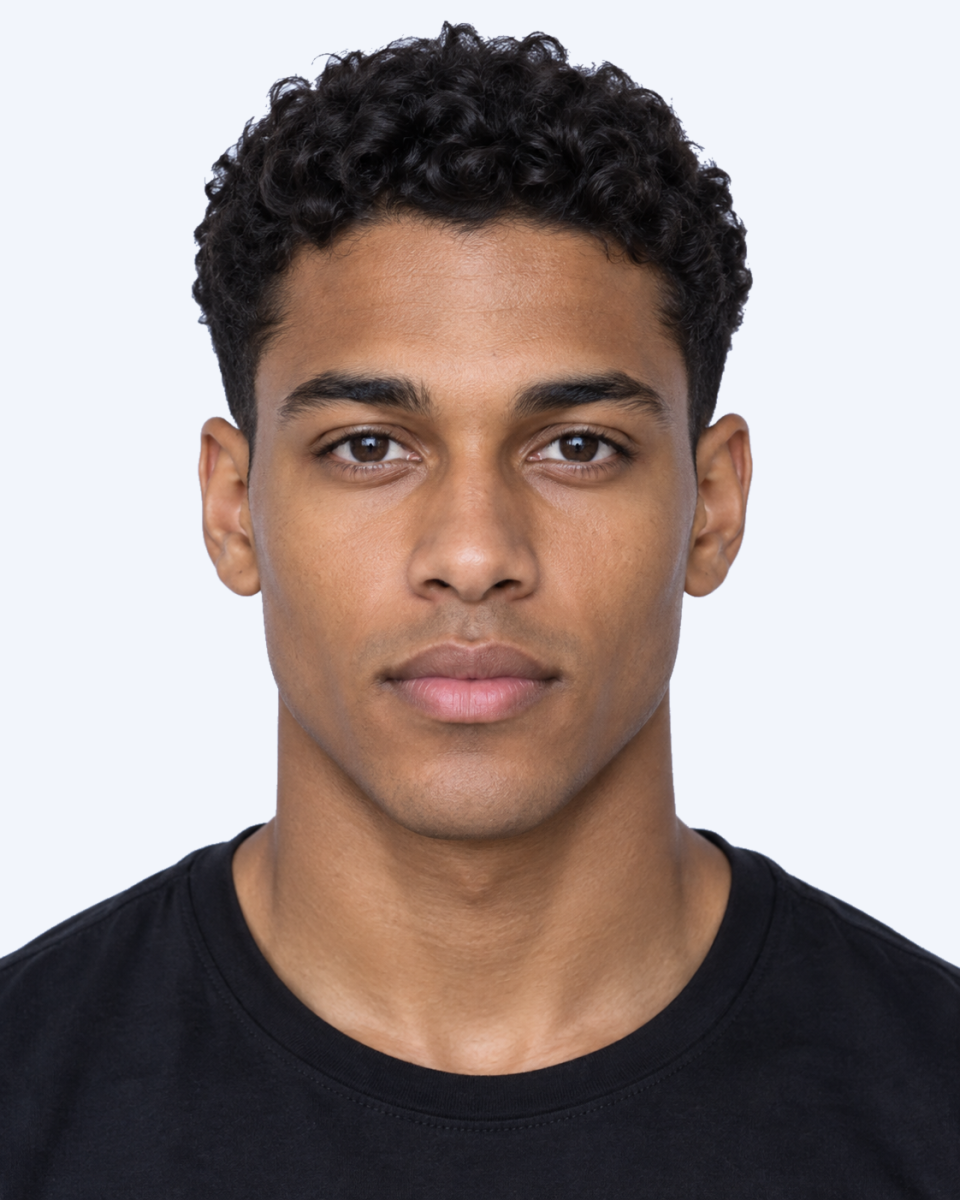
1.11 ratio
Intercanthal-to-eye width ratio
inner-eye gap divided by average visible eye width.
The marked points show where we measure intercanthal-to-eye width ratio.
What different ratios look like
Compare the examples on either side with the original portrait in the centre.
Face A
Face B
The gap around the nasal bridge
The eye openings provide a nearby scale for the space between them. A gap can look modest beside long eyes and more expansive beside short ones, even when the inner corners stay at the same distance.
It differs from pupil spacing relative to the cheeks. Short eyes around a wide-looking gap can occupy little total facial width. Long eyes around a smaller relative gap can spread the pupils across much of the face. Looking at both comparisons separates local spacing from the size of the whole eye region.
A larger gap or shorter eyes
Moving the inner corners farther apart raises the ratio by increasing the gap. More space appears between the openings, which can make their separation conspicuous. If the eyes also span much of the face, the wide-set impression is visible against the cheeks as well.
Shortening the openings raises the ratio without widening the gap. The space looks larger beside smaller eyes, while the inner corners can remain in place. A high ratio in this setting is better explained by eye length than by assuming the eyes have moved apart.
At a low ratio, closer inner corners reduce the gap, while longer openings make an unchanged gap relatively smaller. Inspect both eyes separately because their average width can conceal a longer opening on one side.
The nose beneath the gap
The nasal base supplies another span directly below the inner-eye gap. A broad gap above a narrow base creates more space around the upper nose. A small gap above a broader base makes the nasal wings extend beyond the inner-eye lines, even if the nose is modest within the face.
Nose-to-face width helps distinguish those cases. If the nose is broad against the cheeks too, nasal size contributes more to the contrast. If its facial share is modest, a narrow eye gap may explain why it looks broad locally.
These ratios move together when they share a distance. Widening the gap raises gap-to-eye width and lowers nose-to-gap width while the eye openings and nasal base stay unchanged. They describe the same extra space rather than separate anatomical changes.
The one-eye-width reference
The traditional reference places an eye-width gap between the openings. The 0.95–1.05 interval describes approximate equality, making the arrangement easy to picture. Attractive-model studies have also found longer eyes relative to the gap, so equal spacing is not a requirement of an attractive eye region.
Naran and colleagues altered spacing in 16 female faces and collected ratings from 490 observers. A modest increase in intercanthal distance improved ratings among the tested versions.
Growth and changes in eye length
The gap and eye openings develop at different rates, so their ratio can change as the eye region grows. Population differences in these dimensions also affect which relationships are common in a reference sample.
Adult eyelid studies have documented shorter horizontal openings with age. That can make the gap-to-eye ratio rise even if the inner corners remain the same distance apart. Comparable earlier photographs help distinguish widening of the gap from shortening of the openings.
How we measure it
We measure the gap between the inner eye corners and divide it by the average width of the two eyes.
- 1
Measure between the inner corners of the eyes.
- 2
Measure each eye from inner to outer corner and average the two widths.
- 3
Divide the inner-eye gap by average eye width.
Getting a clear photograph
- Use a straight-on portrait with the camera near eye height and the head upright.
- Avoid close wide-angle selfies; perspective changes central features relative to the facial outline.
- Squinting shortens eye width and raises the ratio without changing spacing.
- Heavy inner-corner makeup can obscure the true inner eye corners.
Check the marked points
- Confirm all four eye corners sit at visible eyelid junctions.
- Check both eyes are naturally and similarly open.
- Retake if liner, lashes or shadow conceal either corner.
What can change the appearance?
Outer-eye emphasis
Extending liner, lashes or shadow laterally increases apparent eye width and lowers the perceived gap-to-eye ratio. Makeup extends the outer edge without changing the inner eye corners.
Keep the inner and outer eye corners clear of makeup when taking the measurement photograph.
Measure your intercanthal-to-eye width ratio
Upload a front-facing photograph to see your result and review the marked points.
Sources
- 1 Do the neoclassical canons still describe the beauty of faces? An anthropometric study on 50 Caucasian models
Selected Italian female models departed from several classical eye, nose, mouth and vertical canons; their proportions are descriptive findings.
- 2 More Than Meets the Eye: The Effect of Intercanthal Distance on Perception of Beauty and Personality
490 observers rated altered spacing in 16 female faces; modest widening improved attractiveness ratings within the tested configurations.
- 3 Age- and sex-related changes in the soft tissues of the orbital region
Documents age and sex differences in eye-region dimensions; orbital dimensions are not interchangeable with central eyelid-opening height.
- 4 Quantitative 3-dimensional Geometry of the Aging Eyelids
In 46 white women, eye-opening width and height decreased with age, with width decreasing faster. Relative roundness need not mean a larger eye opening.
- 5 A systematic review of interethnic variability in facial dimensions
Documents population variation, particularly in forehead height, interocular distance and nasal width; it does not compare attractiveness.
- 6 Glowometry front-view measurement protocol
Explains how the measurement is calculated and which reference range is used.
- 7 Cosmetic makeup enhances facial attractiveness and affective neural responses
Reviews and tests the eye-size illusion produced by eyeliner, mascara and eye shadow.
- 8 Regional contrast changes and facial attractiveness related to cosmetic use
Finds that controlled upper-eye makeup increased attractiveness while lower-eye makeup did not.
- 9 Reliability of measurements taken from facial photographs
Documents the effect of photographic setup and landmark placement on facial measurements.
- 10 Focal length affects depicted shape and perception of facial images
Shows that camera focal length changes depicted facial shape, measured proportions and attractiveness ratings.
Related guides

Interpupillary-to-face width ratio
Pupil spacing relative to cheekbone width, and the difference between eye size and separation.
Eye width-to-face width ratio
Eye width relative to the cheeks, and how opening height changes the appearance of eye size.

Nose-to-intercanthal width ratio
Nasal-base width relative to the inner-eye gap, with examples of the widths matching or differing.