Eye width-to-face width ratio
Eye width-to-face width ratio compares the average corner-to-corner width of one eye with cheekbone width. Higher values mean the openings occupy more of the face horizontally; lower values mean they occupy less.
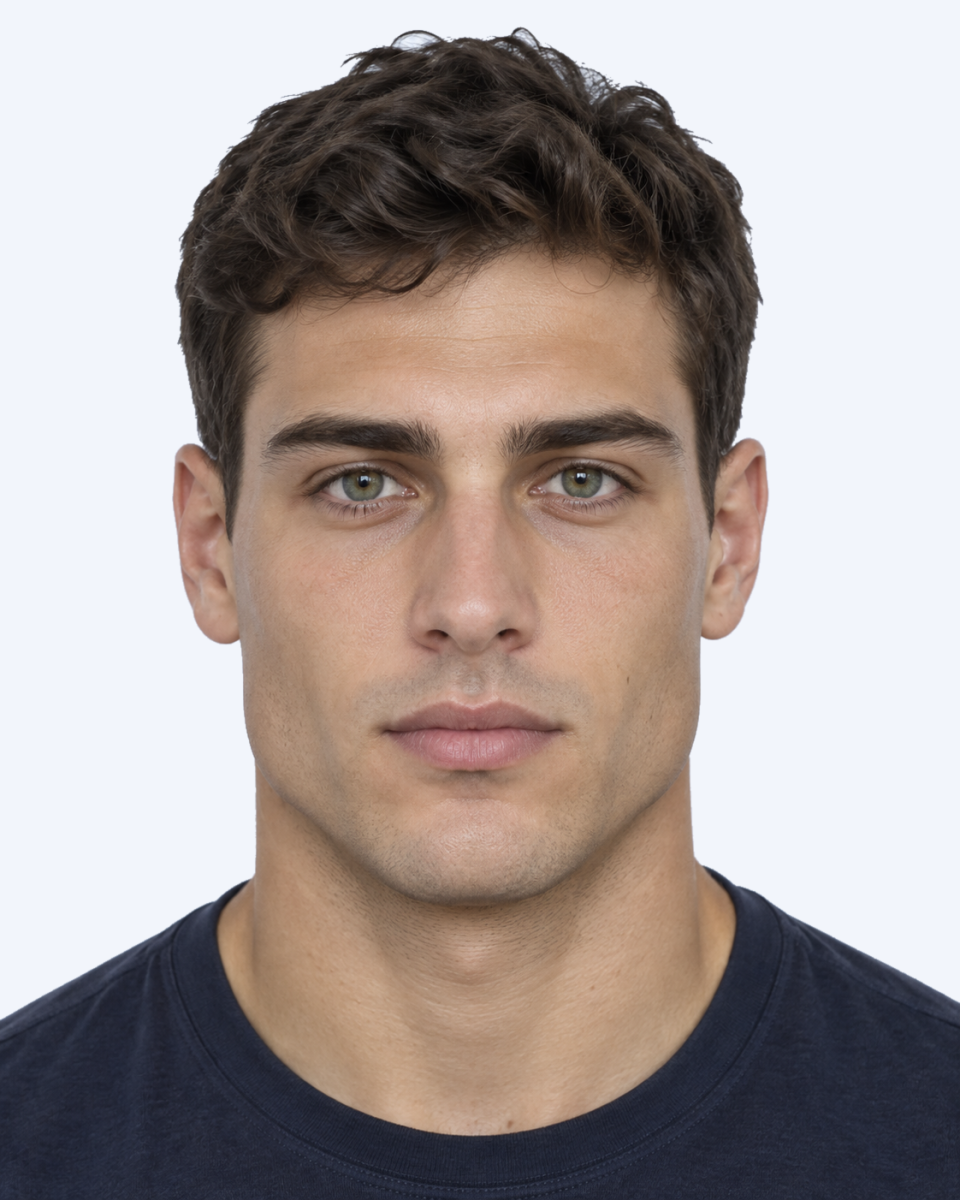
0.21 ratio
Eye width-to-face width ratio
average visible eye width divided by cheekbone width.
The marked points show where we measure eye width-to-face width ratio.
What different ratios look like
Compare the examples on either side with the original portrait in the centre.
Baseline comparison
Eye width within the facial outline
Narrower cheeks can make unchanged eyes look larger because each opening occupies more of the face. Broadening the cheeks has the opposite effect, leaving more facial width around the eye region.
Opening height adds the other dimension. A long eye can remain low and elongated, while a shorter eye can be tall and round. Relative width explains how much space the opening occupies across the face; aspect ratio explains its height compared with that length.
Long openings or a narrow face
Longer eye openings raise the ratio within the same facial outline. Their placement affects where that extra length appears: outer corners farther to the sides occupy more lateral space, while inner corners closer to the bridge reduce the central gap.
A narrower face also raises the ratio around ordinary-length eyes. If the nose and mouth look large relative to the cheeks too, the result may reflect generally substantial features within a narrow outline. Eyes that stand out against those neighbours as well are more specifically prominent through their own width.
A low ratio can similarly come from short eyes or broad cheeks. Short openings around a large gap produce a different eye region from longer openings surrounded by a broad facial outline. Comparing eye length with the inner gap helps distinguish those arrangements.
Opening height and corner direction
High relative width with a low aspect ratio describes long, low eyes. Their prominence comes mainly through horizontal extent. High relative width with a taller opening gives the eyes more presence in both dimensions and a more open appearance.
Shorter eyes can also be round or low. A high aspect ratio in a short opening creates relative roundness without making it large within the face. Low width and low opening height create a smaller aperture overall, although a partial blink should be ruled out before treating that as the usual shape.
Canthal tilt determines the direction of the opening. A rising corner line across a long eye carries a diagonal through more of the eye region than the same slope across a short eye. The inner gap then determines how much space separates the pair, while pupil-to-face width describes their combined placement within the cheeks.
Eye size and attractiveness
Torsello and colleagues found relatively enlarged eyes compared with several classical proportions in their selected female models. Mogilski and Welling also found that eye size affected rankings when varied alongside other features.
The 18–22% reference places each eye around one fifth of cheekbone width; the cited studies do not establish those endpoints as preferred limits for this exact measurement.
Growth and adult changes in eye width
The eye region and surrounding face grow at different rates. As the cheeks broaden, the eyes can occupy a smaller share even while their own width increases. The changing ratio can therefore reflect growth of the facial outline rather than shrinking eyes.
In adulthood, the openings themselves can shorten. Flores and colleagues documented reduced horizontal eye-opening width with age in their sample. This lowers relative eye width through a different route from broader cheeks. Compare the corner-to-corner spans in similarly posed photographs to locate which part has changed.
Comparing the openings
Check each eye before relying on the average. One opening may be longer than the other, and head rotation can make the nearer eye appear larger. Use a frontal photograph with a relaxed gaze and clearly visible inner and outer corners.
How we measure it
We average the widths of both eyes, measured from inner to outer corner, and divide by cheekbone width.
- 1
Measure each eye from its inner corner to its outer corner.
- 2
Average the eye widths and measure across the widest cheekbone points.
- 3
Divide average eye width by cheekbone width.
Getting a clear photograph
- Use a straight-on portrait with the camera near eye height and the head upright.
- Avoid close wide-angle selfies; perspective changes central features relative to the facial outline.
- Squinting and partial blinking shorten the visible eye aperture.
- Liner, lashes and shadow can conceal the true eye corners.
Check the marked points
- Confirm all four eye corners and both cheekbone points.
- Check that neither eye is partially closed.
- Retake without obscuring eye makeup or a blink.
What can change the appearance?
Lateral eye extension with makeup
Upper liner, outward shadow and lashes can extend the apparent lateral eye boundary and increase perceived eye width. The makeup continues the upper-lid line beyond the outer eye corner.
Keep the eye corners clear of liner and lashes when taking a measurement photograph.
Measure your eye width-to-face width ratio
Upload a front-facing photograph to see your result and review the marked points.
Sources
- 1 Do the neoclassical canons still describe the beauty of faces? An anthropometric study on 50 Caucasian models
Selected Italian female models departed from several classical eye, nose, mouth and vertical canons; their proportions are descriptive findings.
- 2 The Relative Contribution of Jawbone and Cheekbone Prominence, Eyebrow Thickness, Eye Size, and Face Length to Evaluations of Facial Masculinity and Attractiveness: A Conjoint Data-Driven Approach
922 observers ranked combinations of manipulated features. Feature importance depended on the task and the variation tested.
- 3 Craniofacial growth: a three-dimensional soft-tissue study from 6 years to adulthood
Documents unequal growth of facial regions, including greater proportional growth of the lower third.
- 4 Quantitative 3-dimensional Geometry of the Aging Eyelids
In 46 white women, eye-opening width and height decreased with age, with width decreasing faster. Relative roundness need not mean a larger eye opening.
- 5 Glowometry front-view measurement protocol
Explains how the measurement is calculated and which reference range is used.
- 6 Cosmetic makeup enhances facial attractiveness and affective neural responses
Reviews and tests the eye-size illusion produced by eyeliner, mascara and eye shadow.
- 7 Regional contrast changes and facial attractiveness related to cosmetic use
Finds that controlled upper-eye makeup increased attractiveness while lower-eye makeup did not.
- 8 Reliability of measurements taken from facial photographs
Documents the effect of photographic setup and landmark placement on facial measurements.
- 9 Focal length affects depicted shape and perception of facial images
Shows that camera focal length changes depicted facial shape, measured proportions and attractiveness ratings.
Related guides
Eye aspect ratio
Eye-opening height relative to width, and the difference between roundness and size.
Intercanthal-to-eye width ratio
The inner-eye gap relative to eye width: a larger gap and shorter eyes can produce the same ratio.
Interpupillary-to-face width ratio
Pupil spacing relative to cheekbone width, and the difference between eye size and separation.