Frontal jaw angle
Frontal jaw angle describes how sharply the lower face narrows from the jaw corners towards the chin. A larger angle between the directed jaw-side lines means stronger inward convergence; a smaller angle means more nearly parallel sides.

+91.99°
Frontal jaw angle
the angle between the two sides of the jaw.
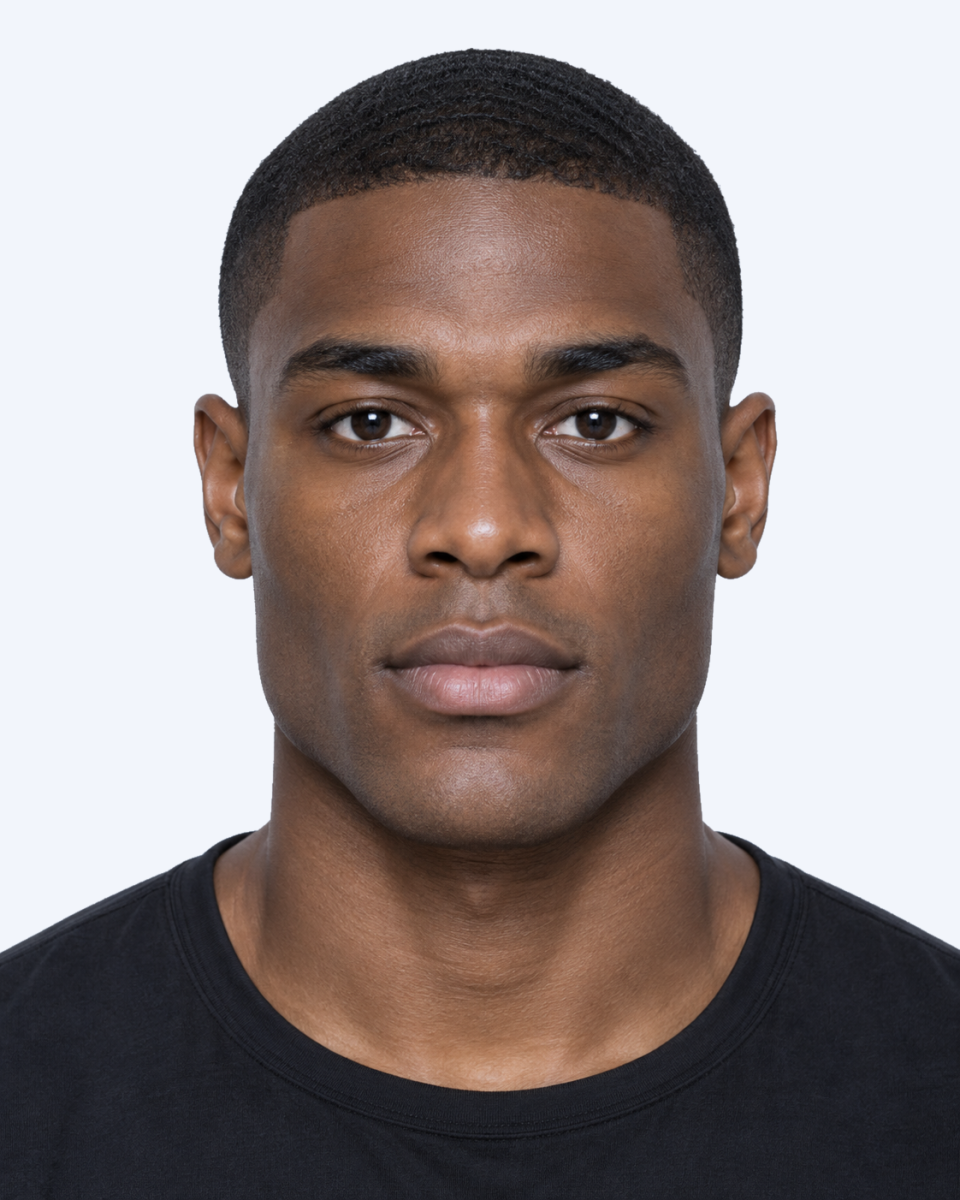
The marked points show where we measure frontal jaw angle.
What different angles look like
Compare the examples on either side with the original portrait in the centre.
Baseline comparison
The slope towards the chin
The sides of the lower face can descend almost vertically or turn inward towards a narrower chin. The measured lines follow this transition from each jaw corner to the corresponding side of the front chin contour. More inward slope increases the angle between them.
The slope depends on how much width is lost and how far the lines descend. A wide jaw leading to a narrow chin over a short distance creates an abrupt taper. The same change in width spread over more height creates straighter-looking sides and a smaller angle. This is a frontal construction; the gonial angle seen in profile follows a different part of the jaw.
Changes that increase or reduce taper
Moving the jaw corners farther apart makes the lines travel farther inward to reach the same chin. Narrowing the chin has a similar effect while leaving the corners in place. Both increase the angle, but one adds breadth at the sides and the other creates a finer ending below the mouth.
The vertical distance matters even when both widths stay fixed. Bringing the chin-side points closer to the level of the corners makes the transition steeper and raises the angle. Extending that distance lowers it. A smaller result can therefore belong to a long, narrow jaw as well as a broad, square one.
Several dimensions can change together without changing the slope. Wider corners paired with a wider chin may preserve the angle, as may a longer descent paired with a larger difference in width. Faces with matching angles can still differ substantially in the size of the lower face.
Taper within a broad or narrow jaw
A high angle with broad jaw corners and a narrow chin describes a lower face that is wide at the sides and strongly tapered at the front. With narrower corners, a similar angle belongs to a finer lower face. Bigonial and chin-width ratios help locate this difference instead of treating every pronounced taper as the same shape.
At a low angle, broad corners and a broad chin can form a rectangular outline. When both are narrow, nearly parallel sides can instead create a long, slender shape. Lower-face height helps distinguish these arrangements, although the relevant distance runs between the marked jaw and chin points rather than across the entire lower third.
The neck affects how clearly these sides can be seen. A narrower neck leaves more separation beneath the jaw, while a broad neck may make the outline more continuous. Facial hair and soft-tissue curvature can also change the visible edge without changing the slope between its endpoints.
Growth and the surface contour
Mandibular growth changes the widths and heights that form the lower face. The taper develops through their combined proportions, so it may change as the chin gains height or the jaw corners broaden. Ferrario's growth study and Velemínská's work on facial size describe some of the wider changes accompanying this development.
The photographed outline follows skin and muscle over the bone. A rounded jaw edge and a sharply defined edge can share the same endpoints, even though their contours differ between them. When comparing photographs over time, check whether the landmarks still mark equivalent parts of the outline.
Angle conventions and preference research
The 85–95° reference belongs to the two directed lines shown in the figure. Some jaw-angle measurements instead use a single point at the chin or measure the jaw in profile. A similar number under one of those definitions can describe different geometry, so the endpoints and angle direction need to match before values are compared.
The female-jaw experiment cited below varied jaw width and height, while Mogilski and Welling varied jaw prominence alongside other facial features. Neither isolated this exact angle.
Checking the marked lines
Inspect each side separately before relying on the combined angle. Unequal corner heights or a chin shifted to one side can create different slopes while leaving the total angle similar. Accurately placed points should follow that difference rather than be moved to make the sides match.
Use a frontal photograph with the jaw relaxed and the chin contour visible. Turning the head changes the apparent widths, while tilting it can shorten or lengthen the descent seen in the image.
How we measure it
We draw a line along each side of the lower jaw, from its back corner toward the chin, and measure the angle between the two lines.
- 1
Mark the left jaw corner and the left side of the chin, then join them.
- 2
Repeat on the right side.
- 3
Measure the smaller angle between the two jaw lines.
Getting a clear photograph
- Use a straight-on portrait with the camera near eye height and the head upright.
- Avoid close wide-angle selfies; perspective changes central features relative to the facial outline.
- Clenching the jaw makes the chewing muscles more prominent and can make the sides look straighter.
- Beards and strong side-light can replace the true skin boundary with a false edge.
Check the marked points
- Confirm all four points follow the skin contour rather than facial hair.
- Check both jaw-corner points without moving them to force symmetry.
- Retake if the face is rotated or the jaw is clenched.
What can change the appearance?
Facial-hair edge design
A defined beard edge can make the jawline look straighter or more tapered. The edge of the beard changes the visible slope beneath the jaw corners.
The beard edge changes the visible outline. Use a photograph with the skin contour visible to measure the jaw beneath it.
Measure your frontal jaw angle
Upload a front-facing photograph to see your result and review the marked points.
Sources
- 1 Craniofacial growth: a three-dimensional soft-tissue study from 6 years to adulthood
Documents unequal growth of facial regions, including greater proportional growth of the lower third.
- 2 Surface facial modelling and allometry in relation to sexual dimorphism
Relates facial size to shape and sex-related morphology in young Central European adults; larger faces were more elongated.
- 3 Analysis of Sexual Dimorphic Features of the Jawline and Chin in White Celebrity Faces
Describes lower-face breadth, length and taper in selected male and female celebrity faces; cohort means are not experimental optima.
- 4 Perceptions of female jaw angles, intergonial widths and gonial heights
Tests 24 controlled intergonial-width states with orthodontists, surgeons and lay observers.
- 5 The Relative Contribution of Jawbone and Cheekbone Prominence, Eyebrow Thickness, Eye Size, and Face Length to Evaluations of Facial Masculinity and Attractiveness: A Conjoint Data-Driven Approach
922 observers ranked combinations of manipulated features. Feature importance depended on the task and the variation tested.
- 6 Glowometry front-view measurement protocol
Explains how the measurement is calculated and which reference range is used.
- 7 Facial masculinity and beardedness interact in attractiveness judgments
Tests facial-hair states across masculinized and feminized face shapes in 8,520 ratings.
- 8 Reliability of measurements taken from facial photographs
Documents the effect of photographic setup and landmark placement on facial measurements.
- 9 Focal length affects depicted shape and perception of facial images
Shows that camera focal length changes depicted facial shape, measured proportions and attractiveness ratings.
Related guides

Bigonial width ratio
Jaw width relative to the cheekbones, from a tapered lower face to a broader outline.
Chin width ratio
Chin width and its effect on the lower face, alongside chin height and jaw shape.

Ipsilateral alar angle
The triangle between the outer eye corners and nasal base, compared with the shape of the nose and jaw.