Nose-to-intercanthal width ratio
Nose-to-intercanthal width ratio compares the width across the nasal wings with the gap between the inner eye corners. At one, the widths match. A higher ratio means the nasal base is broader than the gap; a lower ratio means it is narrower.

1.19 ratio
Nose-to-intercanthal width ratio
nasal-base width divided by inner-eye gap.
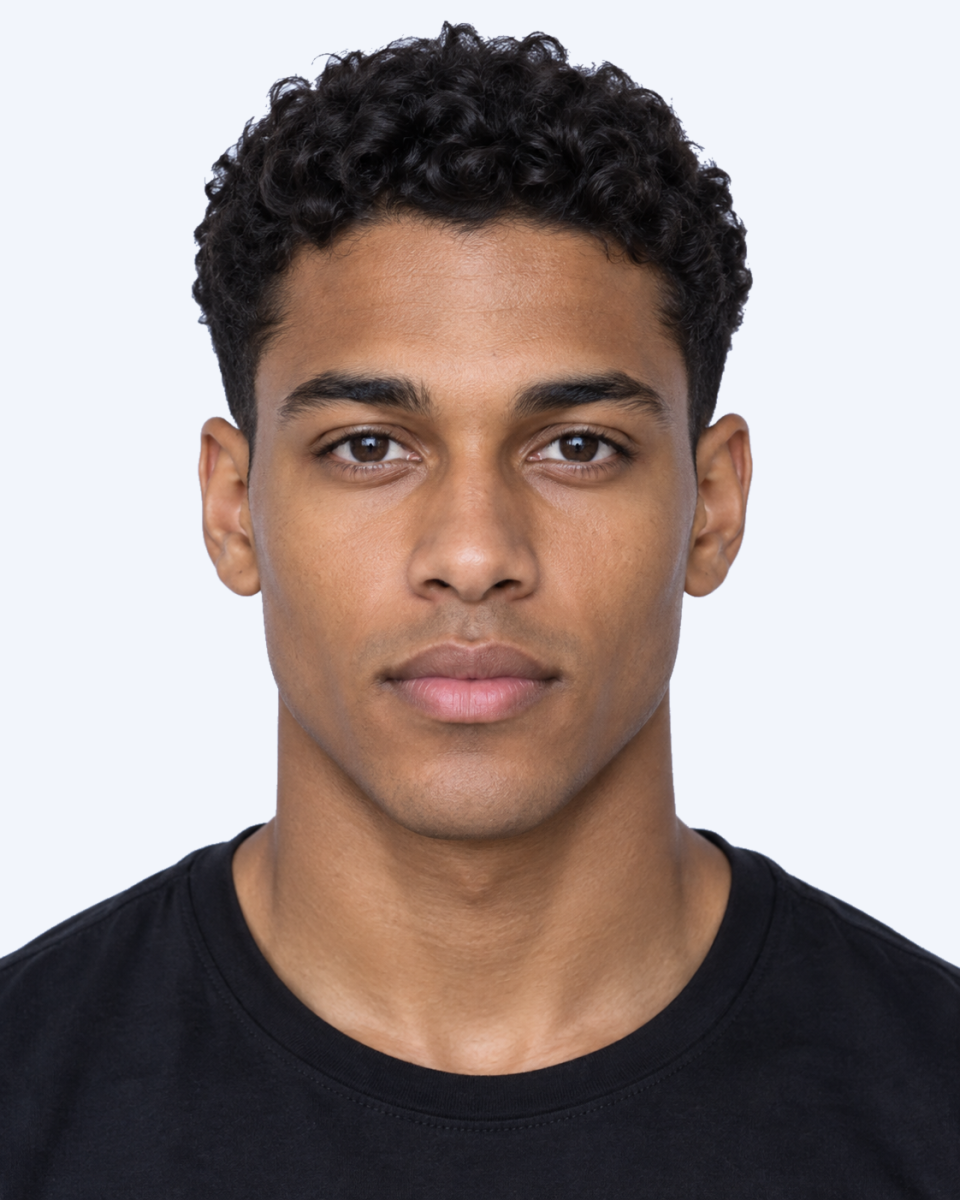
The marked points show where we measure nose-to-intercanthal width ratio.
What different ratios look like
Compare the examples on either side with the original portrait in the centre.
Baseline comparison
The nasal base beneath the eyes
The inner eye corners provide a nearby reference for the nasal wings. Vertical lines drawn down from those corners show whether the wings sit inside the eye gap or extend beyond it.
The cheekbones provide a wider comparison. A nose can extend beyond the inner-eye lines while still occupying a modest share of the face, particularly when the eyes are close together. A nose inside those lines can also be substantial within the face if the eye gap is wide.
Nasal breadth and eye spacing
Widening the nasal base raises the ratio while leaving the inner-eye gap unchanged. The wings extend farther to the sides, increasing the nose's horizontal presence. If nose-to-face width is also high, that breadth is visible against both the eye gap and the cheeks.
A smaller eye gap can raise the result around an otherwise moderate nasal base. The wings appear wider than the space above them because that space is narrow. Comparing the gap with eye width helps show whether close inner corners contribute to the result.
At a low ratio, the distinction reverses. A narrow nasal base can fit well inside an ordinary eye gap, while a broad gap can make a substantial base look narrow beneath it. These configurations may share a number but give different impressions of the nose's size.
Nasal height and mouth width
Height changes the appearance of a given nasal width. A broad base beneath a short nasal region can create a compact shape, while the same breadth in a tall nose occupies more of the centre in both directions. A narrow base may belong to a small nose or to a long, slender one. Nose height-to-width separates these possibilities.
Below the nose, a wide mouth can continue the central breadth. The nasal wings may extend beyond the inner-eye lines while the mouth extends farther still, creating a gradual widening downwards. With a narrow mouth, the same nasal base becomes a more conspicuous span between the eyes and lips.
These comparisons share distances. Widening the eye gap lowers nose-to-gap while raising gap-to-eye width, even if the nose and eyes themselves stay unchanged. The results describe the same increase in space from different reference points.
The equal-width reference
The traditional equal-width canon aligns the nasal wings with the inner eye corners. Attractive-model studies have found departures from this alignment. Torsello and colleagues reported nasal widths exceeding the eye gap in their selected female models.
The 1.00–1.17 reference describes a base that matches or modestly exceeds the gap. Zheng and colleagues examined nasal length, base width and intercanthal width together, which gives context for interpreting the arrangement. Their findings do not establish these exact limits as a preferred range for every combination of nasal height and eye spacing.
Growth and population variation
Fang, Clapham and Chung documented variation in nasal breadth and interocular dimensions across populations. Reference values depend on the population sampled and the measurement method.
The nasal region and eye region also develop at different rates. As the nose grows, the base may become wider relative to the earlier-developing eye region. If both the base and gap increase proportionately, the ratio can remain stable despite growth in each.
Expression can produce a more immediate change. Nasal flare or smiling may widen the visible base while eye spacing stays similar. A relaxed frontal photograph makes the comparison easier to repeat.
How we measure it
We divide the width across the outer nasal wings by the gap between the inner eye corners.
- 1
Mark the outer edges of the nasal wings.
- 2
Measure between the inner corners of the eyes.
- 3
Divide nasal-base width by the inner-eye gap.
Getting a clear photograph
- Use a straight-on portrait with the camera near eye height and the head upright.
- Avoid close wide-angle selfies; perspective changes central features relative to the facial outline.
- Smiling and flaring the nostrils widen the nasal base.
- Close wide-angle photography exaggerates central nasal width relative to the eyes.
Check the marked points
- Place nasal-wing points on the outer nasal contour, not the nostril openings.
- Confirm inner eye corners sit at the true eyelid junctions.
- Retake with a neutral nose and mouth and no flare or smile.
Measure your nose-to-intercanthal width ratio
Upload a front-facing photograph to see your result and review the marked points.
Sources
- 1 Do the neoclassical canons still describe the beauty of faces? An anthropometric study on 50 Caucasian models
Selected Italian female models departed from several classical eye, nose, mouth and vertical canons; their proportions are descriptive findings.
- 2 Quantitative analysis of facial proportions and facial attractiveness among Asians and Caucasians
Examines linked nose-length, nose-width and intercanthal proportions in images from a 5,500-face dataset. Relationships and modification results differed between groups.
- 3 A systematic review of interethnic variability in facial dimensions
Documents population variation, particularly in forehead height, interocular distance and nasal width; it does not compare attractiveness.
- 4 Craniofacial growth: a three-dimensional soft-tissue study from 6 years to adulthood
Documents unequal growth of facial regions, including greater proportional growth of the lower third.
- 5 Surface facial modelling and allometry in relation to sexual dimorphism
Relates facial size to shape and sex-related morphology in young Central European adults; larger faces were more elongated.
- 6 Glowometry front-view measurement protocol
Explains how the measurement is calculated and which reference range is used.
- 7 Reliability of measurements taken from facial photographs
Documents the effect of photographic setup and landmark placement on facial measurements.
- 8 Focal length affects depicted shape and perception of facial images
Shows that camera focal length changes depicted facial shape, measured proportions and attractiveness ratings.
Related guides

Nose-to-face width ratio
Nasal-base width relative to the cheekbones, and the effect of the surrounding facial width.

Nose height-to-width ratio
Nasal height relative to wing width, distinguishing a long nose from a narrow one.
Intercanthal-to-eye width ratio
The inner-eye gap relative to eye width: a larger gap and shorter eyes can produce the same ratio.