Facial thirds
Facial thirds compare the heights of the forehead, central nasal region and mouth-and-chin region. Their percentages show how total facial height is distributed. Equal thirds provide a traditional reference for comparison.
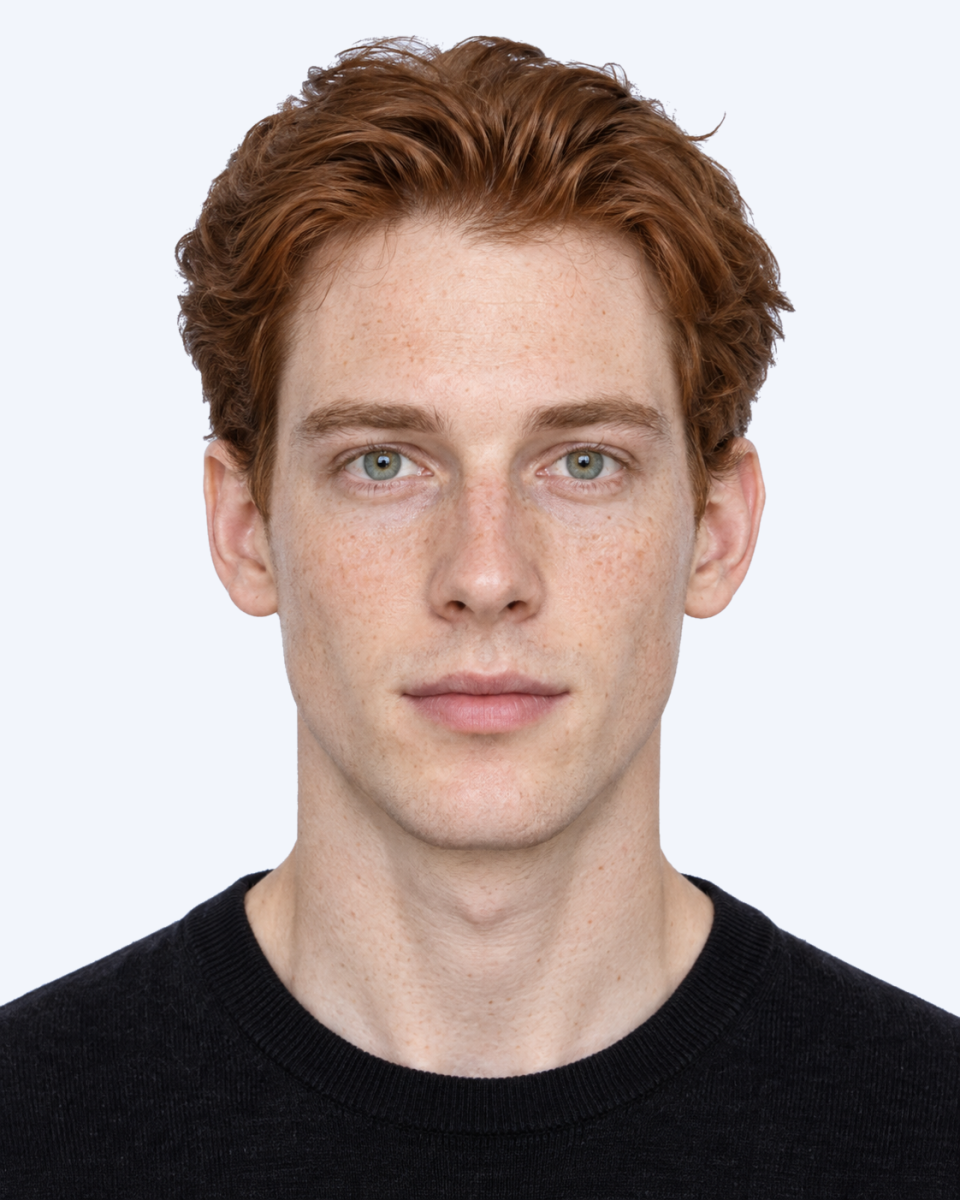
34.0 / 29.6 / 36.4%
Forehead, midface and lower face
each section’s share of the full hairline-to-chin height.
The lines divide the face at the hairline, nasal root, nasal base and chin.
What different proportions look like
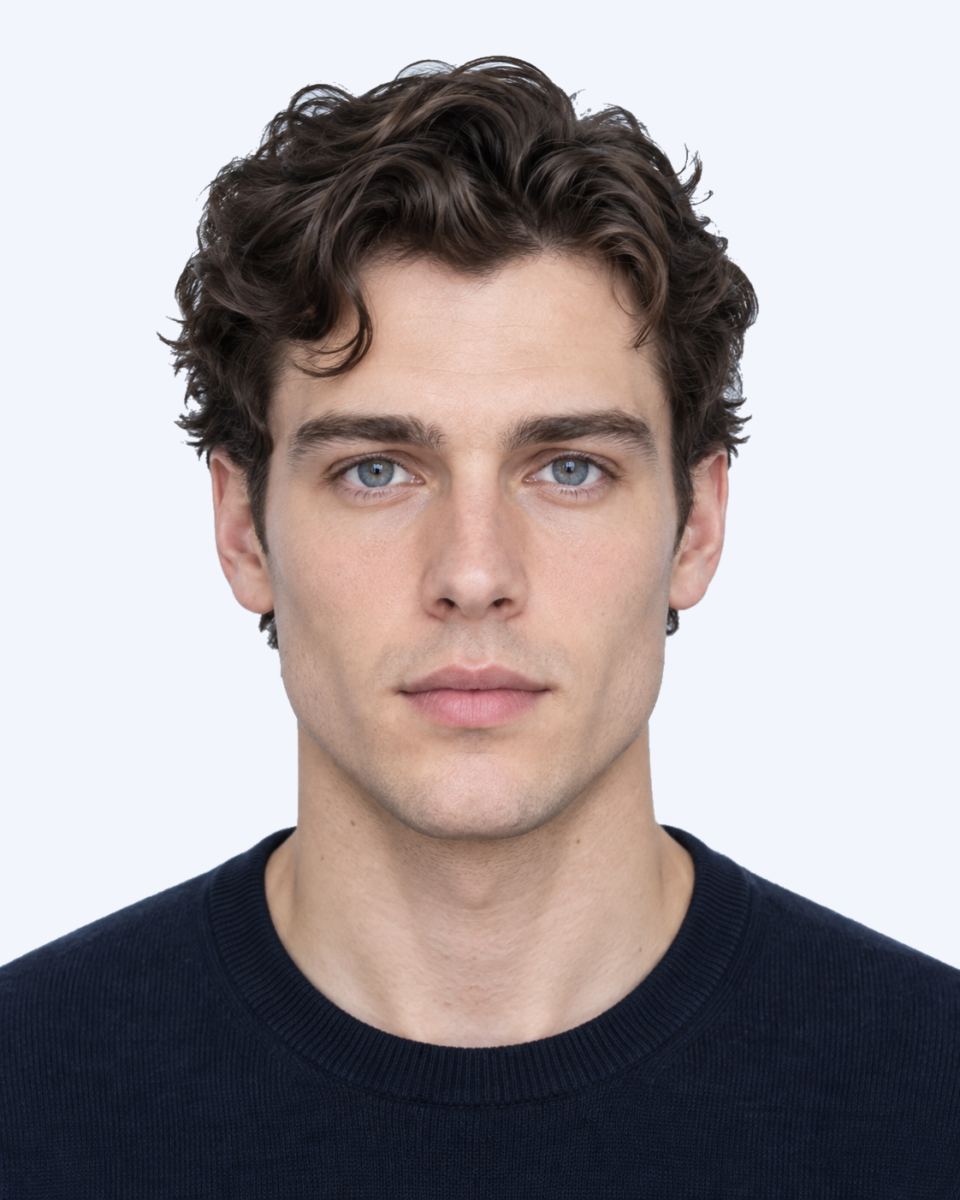
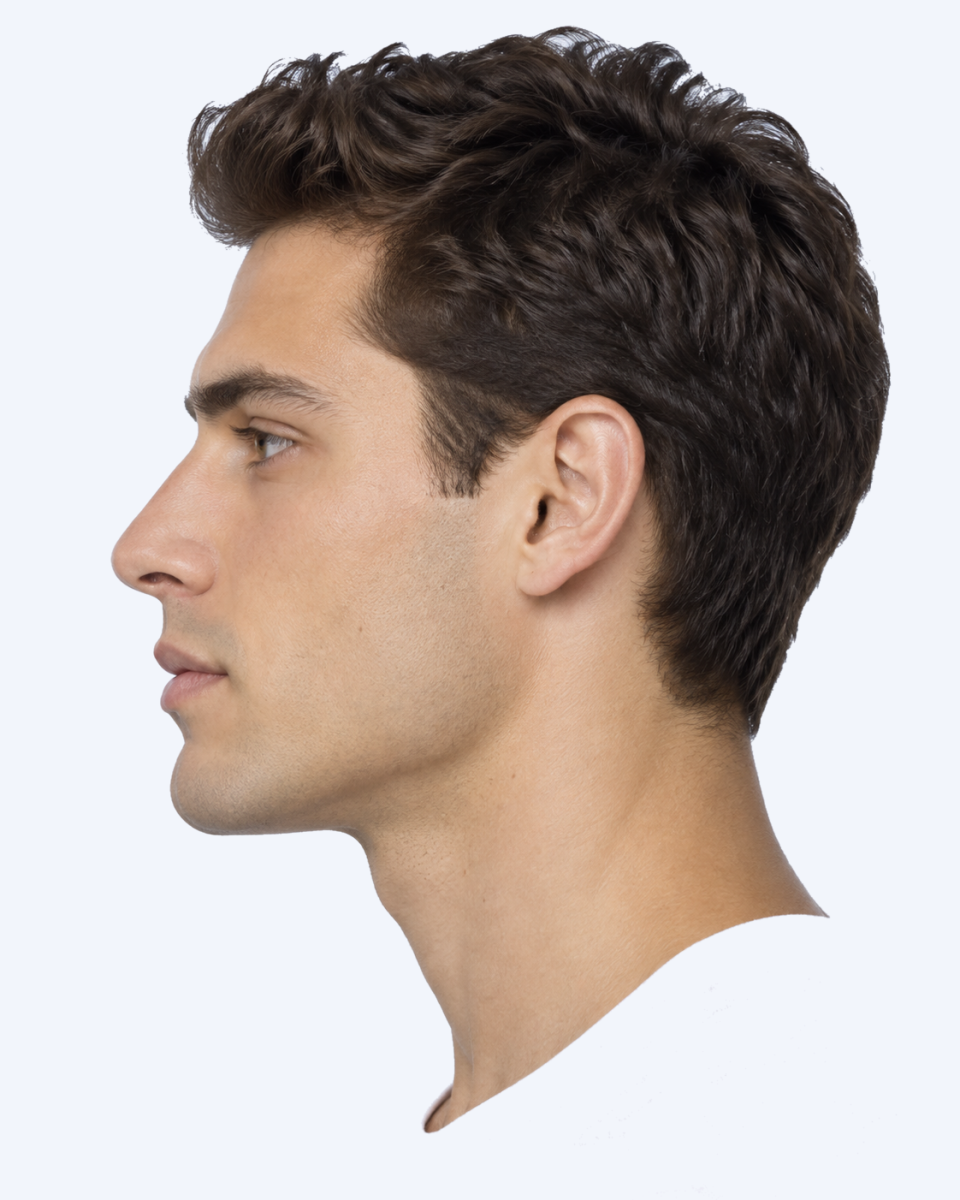
Compare the examples on either side with the original portrait in the centre.
Face A
Face B
The vertical divisions of the face
The upper third runs from the central hairline to the nasal root. The middle third continues to the nasal base, and the lower third ends at the bottom of the chin. Looking at these intervals separately locates height that an overall face-length measurement leaves combined.
Their percentages sum to 100%, so lengthening one region reduces the shares of the others even when their actual heights stay unchanged. A larger lower-third share, for example, does not mean the forehead and nasal region have both shortened.
Equal shares can also occur in a long, narrow face or a short, broad one. Total height-to-width describes the surrounding outline, while the thirds describe how its vertical space is divided.
Forehead height and the hairline
A large upper-third share gives the forehead more of the face's visible height. With broad temples, it can form a substantial upper region; with narrow temples, the same height looks more slender. Lateral hairline recession can expose additional skin even when the central measurement changes little.
Salinas, Liu and Sharaf found differences in lateral forehead and hairline contours that were not captured by central height alone. A small share may reflect a low hairline, but it may also occur because the middle or lower face contributes more height.
The height around the nose
A large middle third allocates more of the total height between the nasal root and base. A tall, narrow nose can reinforce that vertical impression, especially when the eyes are closely spaced. Wider pupil spacing and broader cheeks give the same nasal height a wider surrounding area.
A small middle share may describe a short nasal region or simply a taller forehead and lower face. The eye-to-lip interval extends beyond the nasal base, so a long philtrum can still place the mouth far beneath the eyes. Midface ratio compares pupil spacing with this longer eye-to-lip distance.
Height above and below the mouth
The lower third contains the philtrum above the mouth, the visible lips and the chin region below them. Extra height in the philtrum separates the lips from the nose. Extra height below the lower lip extends the chin, placing the mouth higher within the lower face.
These arrangements can produce the same lower-third share while looking different. Chin-to-philtrum ratio compares the surrounding intervals, and philtrum share shows where the upper lip begins within the full lower face. Lip height needs to be considered between them because fuller lips occupy more of the available space.
Width changes the outline around that allocation. A long lower face with broad corners and a broad chin can look rectangular. The same height ending in a narrow chin produces a more slender taper. A short lower face can likewise be broad and square or narrow and compact.
Growth and adult changes
Ferrario and colleagues documented unequal facial growth, with the lower third showing the greatest proportional increase in their developmental sample. The adult face can therefore gain more height below the nose rather than enlarge evenly across its thirds. Velemínská and colleagues also associated larger faces with greater elongation.
In adulthood, hairline recession can increase the upper interval while changes around the lips affect how height is perceived within the lower face. Compare the relevant contours in earlier photographs when deciding whether a proportion has changed.
Population variation in forehead and nasal dimensions also affects the distribution of thirds in a reference sample. Matching landmark definitions matters when comparing those percentages across studies.
Equal thirds and preference research
Equal thirds describe an arrangement where no region takes much more vertical space than the others. Torsello and colleagues found departures from that canon in selected female models, including a relatively reduced middle third. Attractive faces therefore occur with unequal allocations.
Experiments changing lower-face and chin height in silhouettes found tolerance around reference proportions, with more marked changes receiving lower ratings. Their results concern the particular intervals and silhouettes tested. Height added above the lips changes mouth position differently from height added below them, even if the final lower-third percentages match.
How we measure it
We divide hairline-to-chin height into three sections, using the nasal root and nasal base as the dividing points. Each section is reported as a percentage of total facial height.
- 1
Mark the central hairline, nasal root, nasal base and lowest point of the chin.
- 2
Measure the three sections along the facial centre line.
- 3
Divide each section by total hairline-to-chin height and express it as a percentage.
Getting a clear photograph
- Hair covering the central hairline makes the upper third difficult to measure.
- Looking up, down or to the side changes the visible heights.
- Beard, shadow or a tight crop can hide the bottom of the chin.
- Use even lighting so the nasal base is clearly visible.
Check the marked points
- Check the hairline point at the central skin-to-hair boundary.
- Retake the photograph if the hairline or chin is cropped or hidden.
- Check the bottom point against the skin contour of the chin.
What can change the appearance?
Balance the upper third with hair styling
Fringes, face-framing layers and hairline exposure can make the forehead read shorter or longer, shifting the perceived balance of the facial thirds. The visible hairline frames the top of the face. Covering more of the forehead shortens the apparent upper third, while lifting hair away exposes more height.
Styling changes visual framing, not your anatomical proportions. Keep the central hairline visible when you want an accurate measurement.
Measure your facial thirds
Upload a front-facing photograph to see your result and review the marked points.
Sources
- 1 Analysis of Hairline and Forehead Sexual Dimorphic Aesthetics in 60 Celebrities Using Artificial Intelligence
Shows why central forehead height and lateral hairline shape need separate interpretation in a selected celebrity sample.
- 2 Craniofacial growth: a three-dimensional soft-tissue study from 6 years to adulthood
Documents unequal growth of facial regions, including greater proportional growth of the lower third.
- 3 Surface facial modelling and allometry in relation to sexual dimorphism
Relates facial size to shape and sex-related morphology in young Central European adults; larger faces were more elongated.
- 4 Age- and sex-related changes in three-dimensional lip morphology
Documents age-related changes in lip size and visible vermilion, including declining vermilion-height-to-mouth-width ratios with age.
- 5 A systematic review of interethnic variability in facial dimensions
Documents population variation, particularly in forehead height, interocular distance and nasal width; it does not compare attractiveness.
- 6 Do the neoclassical canons still describe the beauty of faces? An anthropometric study on 50 Caucasian models
Selected Italian female models departed from several classical eye, nose, mouth and vertical canons; their proportions are descriptive findings.
- 7 Influence of lower facial height changes on frontal facial attractiveness and perception of treatment need by lay people
Ratings of two altered frontal silhouettes support tolerance around the baseline rather than a single exact preferred lower-face height.
- 8 Influence of chin height on perceived attractiveness in the orthognathic patient, layperson, and clinician
Shows tolerance of chin-height variation and differences between observer groups. These results cannot be numerically transferred to chin width.
- 9 Vertical and horizontal proportions of the face in young adult North American Caucasians
Tests equality-based vertical canons in a measured adult cohort.
- 10 The boundary of holistic processing in the appraisal of facial attractiveness
Shows that external framing and occlusion, including the hairline and hairstyle, influence how facial attractiveness is perceived.
- 11 Reliability of measurements taken from facial photographs
Explains how photographic setup and landmark placement affect facial measurements.