Bigonial width ratio
Bigonial width is the distance between the back corners of the jaw. Comparing it with cheekbone width describes how much the face narrows below the cheeks. A higher ratio means the jaw retains more of that width; a lower ratio means a stronger taper.

0.82 ratio
Bigonial width ratio
jaw-corner width divided by cheekbone width.
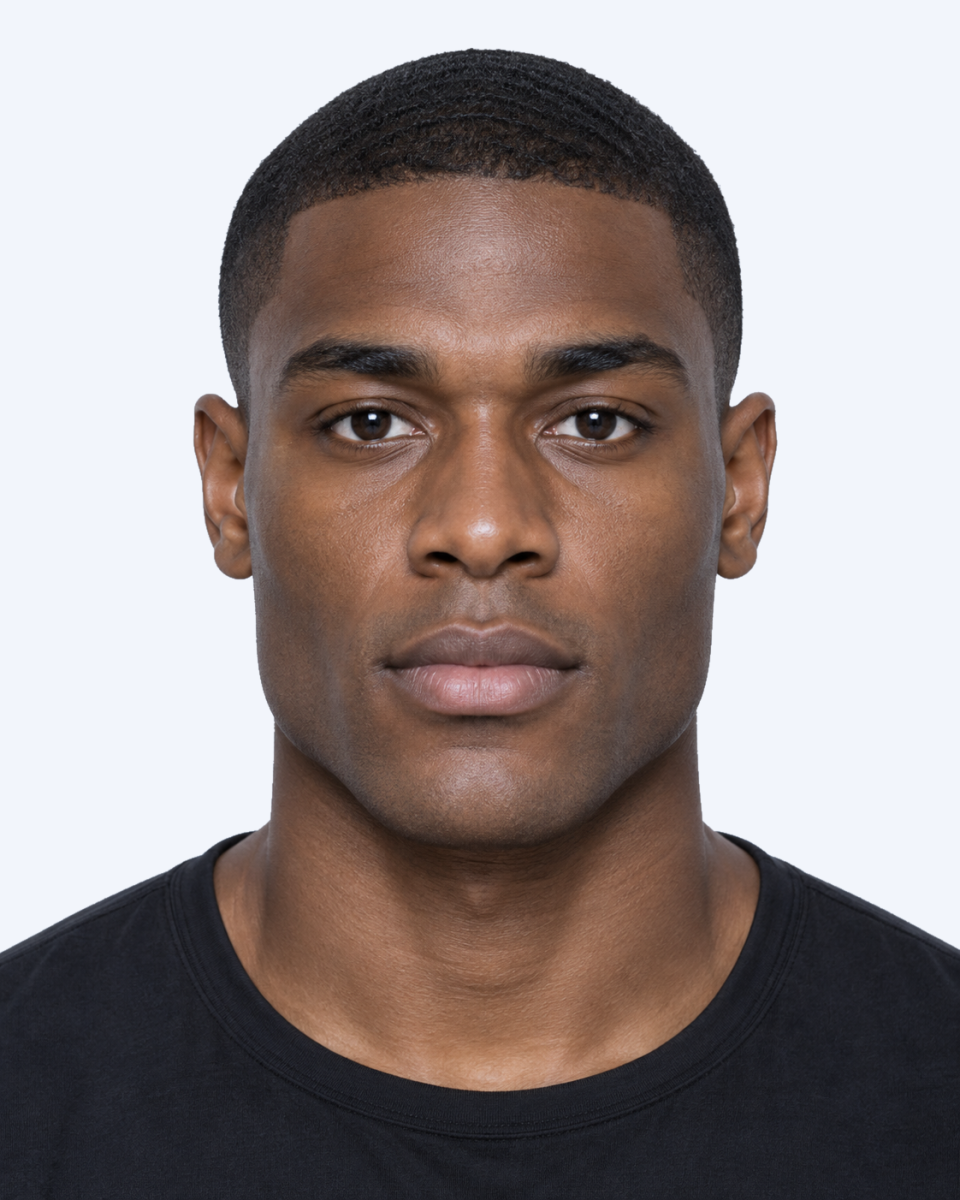
The marked points show where we measure bigonial width ratio.
What different ratios look like
Compare the examples on either side with the original portrait in the centre.
Baseline comparison
The outline below the cheeks
The jaw corners sit at the sides of the lower face, where the outline begins to turn towards the chin. When they are nearly as wide as the cheekbones, the sides of the face look straighter. Corners that sit farther inward make the outline narrow below the cheeks, which can make the cheekbones appear more prominent.
This comparison also explains why a broad jaw does not always look broad relative to the face. Someone with especially wide cheekbones can have substantial jaw width and still receive a low ratio. In a narrower face, a smaller jaw may nearly match cheekbone width and produce a higher result.
The shape between the jaw corners and chin
Jaw-corner width establishes the sides of the lower face, while chin width determines how it finishes. Broad corners leading to a broad chin retain width across the region. With a short lower face, this can look square; with more height, the same widths can form a longer, rectangular outline.
Broad corners can also lead to a narrow chin. The jaw remains wide at the sides but turns inward towards a finer point, so a high bigonial ratio can occur in a tapered lower face. When the corners and chin are both narrow, that taper begins higher, just below the cheeks. Additional height then makes the lower face look more slender and elongated.
A relatively broad chin beneath narrow jaw corners creates less narrowing near the bottom. Its rounded or flatter lower edge becomes more noticeable because the sides above it are already close together.
The temples and neck around the jaw
Narrow temples and a narrow jaw make the cheekbones stand out between them, creating a diamond-like outline. Broader temples above the same jaw give the face a more gradual taper from top to bottom. The jaw can therefore contribute to different overall shapes without changing its own width.
Below the jaw, a narrower neck leaves a visible inward step under the corners. A neck close to jaw width reduces that separation and makes the outline more continuous. This is why a wide jaw may look less defined than a narrower one sitting above a much narrower neck.
Growth and the visible jaw contour
The lower face grows substantially on the way to adulthood. Its width develops alongside its height, and larger adult faces can also differ in shape. In the celebrity sample studied by Salinas, Liu and Sharaf, men had longer and wider lower faces, while women showed more taper towards the chin. The difference involved the whole lower outline rather than jaw width alone.
The visible corners include the masseter muscles and the soft tissue covering the bone. Clenching may make the sides fuller, while other tissue changes can round the contour. A broad span with rounded edges can consequently look quite different from the same span with a sharply turning jawline. Compare relaxed photographs when assessing a change in width or definition.
Jaw width and attractiveness
The 0.75–0.85 reference describes jaw corners that retain substantial width while remaining narrower than the cheeks.
The experiment "Perceptions of female jaw angles, intergonial widths and gonial heights" found a preference for narrower jaw-to-cheek relationships in its female stimuli. Mogilski and Welling also found that jaw prominence affected ratings when varied with other features. These findings concern the faces and alternatives tested; they do not establish the reference interval as a preferred width for every chin shape or lower-face height.
How we measure it
We measure between the two jaw corners and divide that distance by cheekbone width.
- 1
Mark the jaw corners where the sides of the face turn toward the chin.
- 2
Measure across the widest cheekbone points.
- 3
Divide jaw-corner width by cheekbone width.
Getting a clear photograph
- Use a straight-on portrait with the camera near eye height and the head upright.
- Avoid close wide-angle selfies; perspective changes central features relative to the facial outline.
- Facial hair, masseter tension and hard side-light can displace the visible jaw boundary.
- Turning to one side hides a jaw corner and changes the apparent jaw width.
Check the marked points
- Place each jaw-corner point where the side of the face turns toward the chin.
- Confirm that neither point follows beard volume or a cast shadow.
- Retake if the jaw is clenched, rotated or covered.
What can change the appearance?
Facial-hair contouring
A short boxed beard can make the jawline look straighter and wider. Tapering the sides creates a narrower outline. The visible hair edge replaces part of the skin contour, changing apparent jaw width and masculinity without changing bone or soft tissue.
Keep the jaw corners visible in your analysis photograph. A beard can conceal the skin contour and make the jaw appear wider.
Measure your bigonial width ratio
Upload a front-facing photograph to see your result and review the marked points.
Sources
- 1 Craniofacial growth: a three-dimensional soft-tissue study from 6 years to adulthood
Documents unequal growth of facial regions, including greater proportional growth of the lower third.
- 2 Surface facial modelling and allometry in relation to sexual dimorphism
Relates facial size to shape and sex-related morphology in young Central European adults; larger faces were more elongated.
- 3 Analysis of Sexual Dimorphic Features of the Jawline and Chin in White Celebrity Faces
Describes lower-face breadth, length and taper in selected male and female celebrity faces; cohort means are not experimental optima.
- 4 Facial Adiposity, Attractiveness, and Health: A Review
Explains soft-tissue breadth as a contributor to facial appearance and distinguishes perceived adiposity from a direct measure of body composition.
- 5 Perceptions of female jaw angles, intergonial widths and gonial heights
Tests 24 controlled intergonial-width states with orthodontists, surgeons and lay observers.
- 6 The Relative Contribution of Jawbone and Cheekbone Prominence, Eyebrow Thickness, Eye Size, and Face Length to Evaluations of Facial Masculinity and Attractiveness: A Conjoint Data-Driven Approach
922 observers ranked combinations of manipulated features. Feature importance depended on the task and the variation tested.
- 7 Glowometry front-view measurement protocol
Explains how the measurement is calculated and which reference range is used.
- 8 Facial masculinity and beardedness interact in attractiveness judgments
Tests facial-hair states across masculinized and feminized face shapes in 8,520 ratings.
- 9 Reliability of measurements taken from facial photographs
Documents the effect of photographic setup and landmark placement on facial measurements.
- 10 Focal length affects depicted shape and perception of facial images
Shows that camera focal length changes depicted facial shape, measured proportions and attractiveness ratings.
Related guides

Frontal jaw angle
The slope from the jaw corners to the chin, and how width and height affect the taper.
Chin width ratio
Chin width and its effect on the lower face, alongside chin height and jaw shape.

Total face height-to-width ratio
Overall face length relative to cheekbone width, and the regions that contribute to that length.