Facial convexity angle
Facial convexity angle describes the bend between the forehead, nasal base and front of the chin in a side view. The interior angle ranges from 0–180° and is read alongside its direction: convex, near-straight or concave.
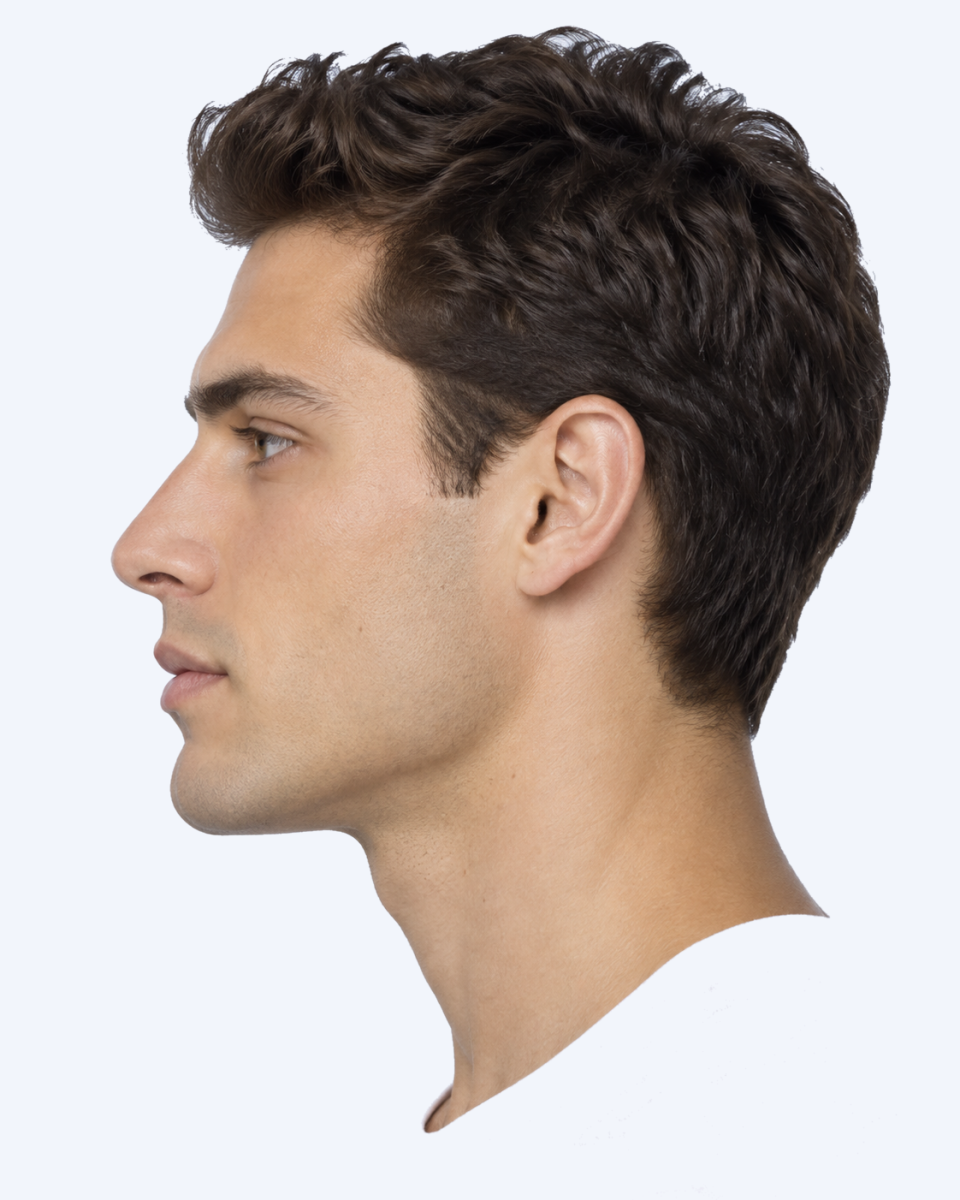
+161.39° · concave
The forehead-to-nose-to-chin profile
the angle at the nasal base, with the direction of the profile bend.
The two lines meet at the nasal base and connect it to the forehead and front of the chin.
What different angles look like
Compare the examples on either side with the original portrait in the centre.
Baseline comparison
The bend through the middle of the profile
The nasal base sits between the forehead and chin in the measured profile. When it lies forward of the line joining them, the profile bends outward through the centre and is described as convex. This can make the nose and upper-lip region look more prominent beside the chin.
As the points approach a straight line, the angle approaches 180°. A bend in the opposite direction is described as concave. The same interior angle can occur on either side of straight, so its direction is needed to distinguish those shapes.
Forehead, nasal-base and chin position
Moving the chin forwards can reduce convexity while the forehead and nasal base stay fixed. Moving it farther back increases the outward bend. This changes how much the chin projects beneath the lips and how prominent the central profile looks by comparison.
The other points can change the angle too. A more forward nasal base increases convexity relative to the same forehead and chin, while a change in the forehead point alters the upper line. Similar angles can therefore belong to profiles with different chin positions.
The nose and lips between the marked points
The middle point is the junction where the nose meets the upper lip. The nasal tip can project farther forwards while that junction stays in place, making the nose more prominent without changing the angle. Likewise, fuller or more projecting lips can alter the contour between the nasal base and chin.
Height affects the line to the chin as well as forward position. A longer lower face gives the same horizontal difference more vertical distance over which to descend.
The profile reference
The high 160s through the mid-170s describe the gently convex to near-straight reference discussed here. Within this region, the nasal base lies relatively close to the alignment between the forehead and chin. A stronger bend makes the difference in forward position more conspicuous.
The silhouette study below compares ratings after changing profile shape. The cohort review describes angles measured among its participants. A measured average and a preferred angle are different findings.
Checking the side view
Use a true side photograph with the lips and jaw relaxed. A three-quarter view changes the apparent outline, while pushing the chin forwards changes the posture being measured. Keep head position and camera height consistent when comparing images.
The chin point belongs on the most forward skin contour rather than the lowest edge. Hair can hide the forehead point and a beard can obscure the chin. If either boundary is unclear, a better photograph is more useful than adjusting the point to fit an expected angle.
What studies found
In the tested silhouettes, straight profiles received higher ratings than convex and concave variants, with ratings declining as deviation increased. This supports a preference within those images, not an exact angle target for every face.
Controlled silhouettes, 2012Available stereophotogrammetric studies place the mean soft-tissue convexity angle around 168°. A cohort mean describes the measured participants; it is not a preferred angle established by a rating experiment.
Normative context, 202381% of treated adults improved at least one validated chin-retrusion grade at week 12 versus 6% of controls. HA filler can change chin projection in appropriately selected adults.
Randomized clinical trial, 2022How we measure it
The angle is formed at the nasal base by lines to the central forehead and the front of the chin. Its direction describes whether the profile bends outward or inward.
- 1
Use a true side photograph and mark the central forehead, nasal base and most forward point of the chin.
- 2
Join the forehead and chin points to the nasal base and measure the interior angle.
- 3
Read the angle with its direction: convex, near-straight or concave.
Getting a clear photograph
- A three-quarter view changes the profile outline; use a true side view.
- Keep the head upright and the camera at a consistent height.
- Hair and beard growth can hide the forehead or chin contour.
- Relax the lips and jaw rather than pushing the chin forward.
Check the marked points
- Check that the three points follow the visible skin contour.
- Use the most forward chin point, rather than the lowest point.
- Retake a three-quarter photograph instead of trying to compensate by moving the points.
What can change the appearance?
Clinician-led hyaluronic-acid chin augmentation
Randomized trials and systematic reviews support temporary improvement in mild-to-moderate chin retrusion with HA filler. Adding volume at the front of the chin brings its contour forward and can make the profile straighter.
The effect is temporary. A qualified clinician should assess chin position and discuss injection risks, including swelling, asymmetry and rare vascular complications.
Profile photography from a consistent distance
Photograph the profile with the head upright and the camera at the same distance each time. Looking up or down changes how the forehead, nasal base and chin line up in the photograph.
Keep the jaw relaxed and avoid lifting the chin to make the profile look straighter.
Measure your facial convexity angle
Upload a side-profile photograph to see your result and review the marked points.
Questions about this measurement
The same angle can occur on either side of a straight profile. Convex means the chin sits farther back relative to the nasal base; concave means it sits farther forward.
No. The middle point is where the nose meets the upper lip. The nasal tip can project farther forward without moving that point.
Sources
- 1 Soft-tissue facial convexity measured through G–Sn–Pg
Documents the G–Sn–Pg soft-tissue angle and landmark convention.
- 2 Influence of natural head position on facial profile measurements
Supports the head-position limitations described for profile photographs.
- 3 Influence of lower facial profile convexity on perceived attractiveness
Compares systematically altered profile silhouettes across patients, clinicians and laypeople.
- 4 Three-dimensional orthodontic imaging and facial convexity
Defines G–Sn–Pg and summarizes published mean values near 168 degrees.
- 5 Randomized trial of hyaluronic acid filler for chin augmentation and chin retrusion
Provides controlled effectiveness and safety results for mild-to-moderate chin retrusion.
- 6 Nonsurgical chin augmentation using hyaluronic acid: systematic review
Synthesizes satisfaction and complication evidence for temporary HA chin augmentation.