Eye-to-mouth angle
Eye-to-mouth angle is formed at the centre of the closed mouth by lines to the two pupil centres. A larger angle describes a wider or shallower triangle; a smaller angle describes a narrower or deeper one.

+48.14°
Eye-to-mouth angle
the angle at the mouth centre between the two pupil centres.
The marked points show where we measure eye-to-mouth angle.
What different angles look like
Compare the examples on either side with the original portrait in the centre.
Baseline comparison
The triangle between the eyes and mouth
The pupils form the upper corners of the triangle and the mouth centre forms its lower corner. With pupil spacing unchanged, bringing the mouth closer to the eye line opens the angle. Moving it farther down makes the triangle deeper and the angle smaller.
Widening pupil spacing also opens the angle, although the mouth stays at the same height. A large angle can therefore describe either widely spanning eyes or a mouth placed relatively close beneath them.
Different arrangements with the same angle
A small angle with ordinary pupil spacing can reflect a long eye-to-mouth distance. More of the central face lies between the eye line and mouth, which may make the region look elongated. The nose and the interval below it determine where that height is distributed.
A small angle with closer pupils creates a narrower triangle without requiring extra height. Inside broad cheeks, it can make the central features look concentrated; inside a narrow face, it may continue the shape of the surrounding outline.
At a larger angle, wide pupil spacing spreads the upper part of the triangle, while a higher mouth makes it shallower. These changes affect different features. Their overall scale can also vary: a large and a small triangle may share an angle while occupying different amounts of the face.
The eye-to-mouth angle study
Danel and Pawlowski examined an eye-mouth-eye angle with its vertex at the mouth and lines through the pupils. Among the young male faces rated by young women, smaller angles and lower angular asymmetry were associated with higher attractiveness ratings.
The study compared photographed faces rather than independently moving the eyes and mouth. It therefore leaves open whether narrower pupil spacing, greater eye-to-mouth height or other accompanying features contributed to the association.
The upper lip, mouth width and facial outline
Midface ratio uses a similar arrangement, but the lower endpoints are not identical. It ends at the top of the upper lip, while this angle ends at the mouth seam. A taller upper lip increases the distance between those points, so the angle may describe a deeper triangle than the midface ratio suggests.
Mouth width adds information that a single point at the mouth centre leaves out. A deep triangle above a wide mouth has a substantial horizontal span at its bottom. The same triangle above a narrow mouth continues the concentration of the central features. Mouth-to-pupil width helps distinguish those arrangements.
The outer face changes the impression again. A deep triangle within a long, narrow face repeats the overall elongation. In a broad, short face, it places more of the visible length at the centre. A shallow triangle can sit between a tall forehead and a long lower chin region without making the entire face compact.
Placement and symmetry
Pallett and colleagues found that changing eye and mouth placement altered attractiveness ratings even when the features themselves stayed the same. Their experiment used different spacing measurements from this angle.
A mouth shifted to one side or pupils at different heights can produce an uneven triangle with the same total angle as a centred one. Inspect the lines on each side before interpreting the number. The asymmetry finding in Danel and Pawlowski's study makes that arrangement particularly relevant.
Growth and mouth position
As the central face grows, the mouth may move farther below the eyes even while pupil spacing increases. If vertical growth is greater in proportion, the angle becomes smaller. If both distances increase proportionately, the angle can remain stable while the measured region grows.
Later changes in lip shape can affect the mouth seam and the appearance around it. Sforza and colleagues documented changes in mouth dimensions and visible lip height with age. A relaxed, closed mouth and direct gaze give more consistent endpoints when comparing photographs.
The angular reference
The 45–50° interval provides a comparison for the illustrated triangle. The observational angle study does not validate those limits as a universal preferred range.
How we measure it
We join each pupil to the centre of the closed mouth and measure the angle where the lines meet.
- 1
Locate the centre of each pupil.
- 2
Draw a line from each pupil to the midpoint of the closed-mouth seam.
- 3
Measure the angle at the mouth.
Getting a clear photograph
- Use a straight-on portrait with the camera near eye height and the head upright.
- Avoid close wide-angle selfies; perspective changes central features relative to the facial outline.
- Smiling moves the mouth centre and can sharply increase the angle.
- Squinting can hide part of the pupils; looking away changes their position within the eye openings.
Check the marked points
- Confirm both iris centres align with the pupils, not eyelid midpoints.
- Place the mouth centre on the midpoint of the relaxed closed-mouth seam.
- Retake if the subject smiles, looks away or tilts the head.
Measure your eye-to-mouth angle
Upload a front-facing photograph to see your result and review the marked points.
Sources
- 1 Eye-mouth-eye angle as a good indicator of face masculinization, asymmetry, and attractiveness (Homo sapiens)
Uses a mouth-centred angle through the pupils; smaller angles and less angular asymmetry were associated with higher ratings of young male faces.
- 2 New “golden” ratios for facial beauty
Within-face experiments tested eye and mouth spacing. Published percentages use specific face-height and inner-ear-width endpoints, not every app ratio.
- 3 Craniofacial growth: a three-dimensional soft-tissue study from 6 years to adulthood
Documents unequal growth of facial regions, including greater proportional growth of the lower third.
- 4 Surface facial modelling and allometry in relation to sexual dimorphism
Relates facial size to shape and sex-related morphology in young Central European adults; larger faces were more elongated.
- 5 Age- and sex-related changes in three-dimensional lip morphology
Documents age-related changes in lip size and visible vermilion, including declining vermilion-height-to-mouth-width ratios with age.
- 6 Glowometry front-view measurement protocol
Explains how the measurement is calculated and which reference range is used.
- 7 Reliability of measurements taken from facial photographs
Documents the effect of photographic setup and landmark placement on facial measurements.
- 8 Focal length affects depicted shape and perception of facial images
Shows that camera focal length changes depicted facial shape, measured proportions and attractiveness ratings.
Related guides
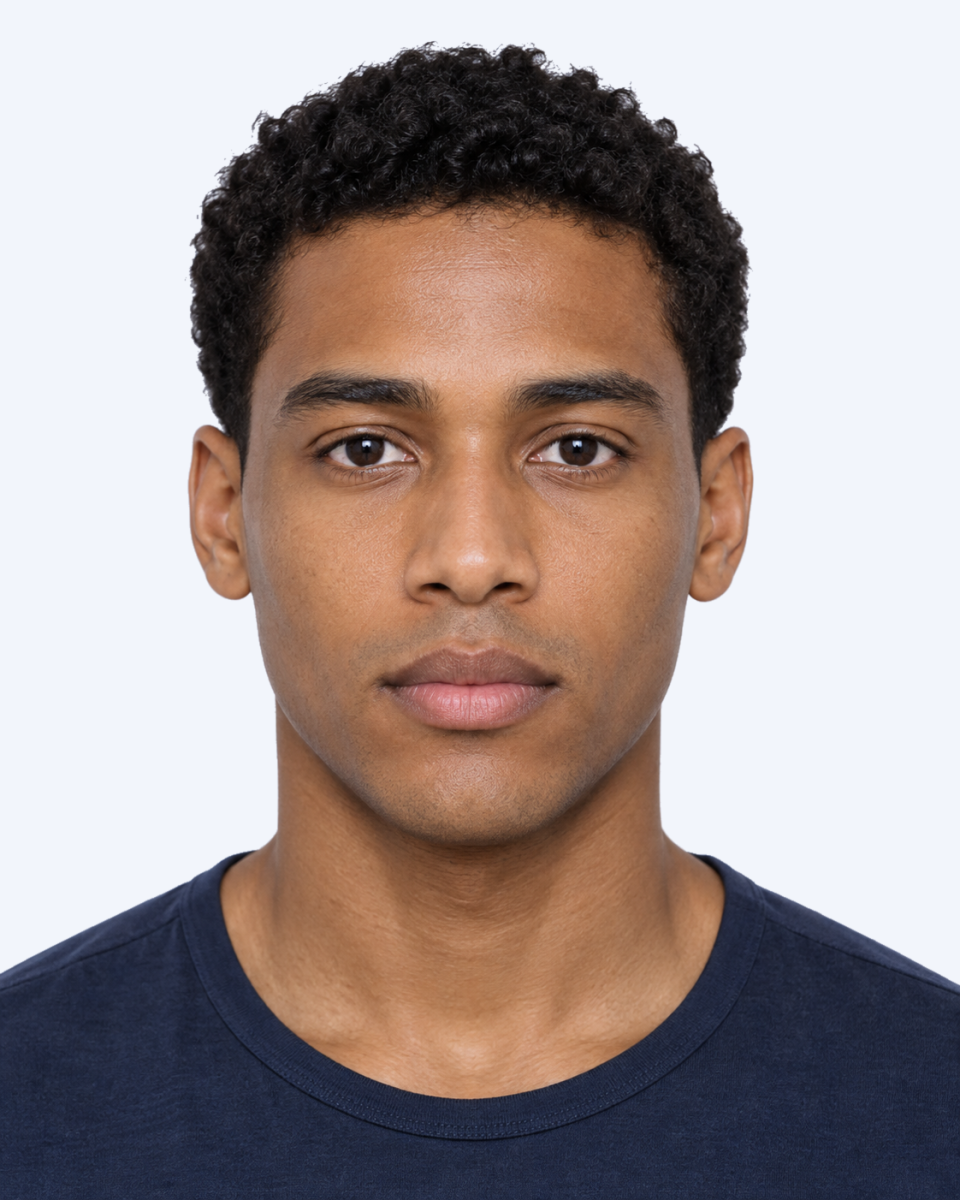
Midface ratio
Pupil spacing compared with eye-to-lip height, and the different facial shapes that can share a midface ratio.

Interpupillary-to-face width ratio
Pupil spacing relative to cheekbone width, and the difference between eye size and separation.

Ipsilateral alar angle
The triangle between the outer eye corners and nasal base, compared with the shape of the nose and jaw.