Interpupillary-to-face width ratio
Interpupillary-to-face width ratio compares the distance between the pupil centres with cheekbone width. Higher values mean the pupils span more of the face; lower values mean they occupy a smaller share.

0.47 ratio
Interpupillary-to-face width ratio
pupil distance divided by cheekbone width.
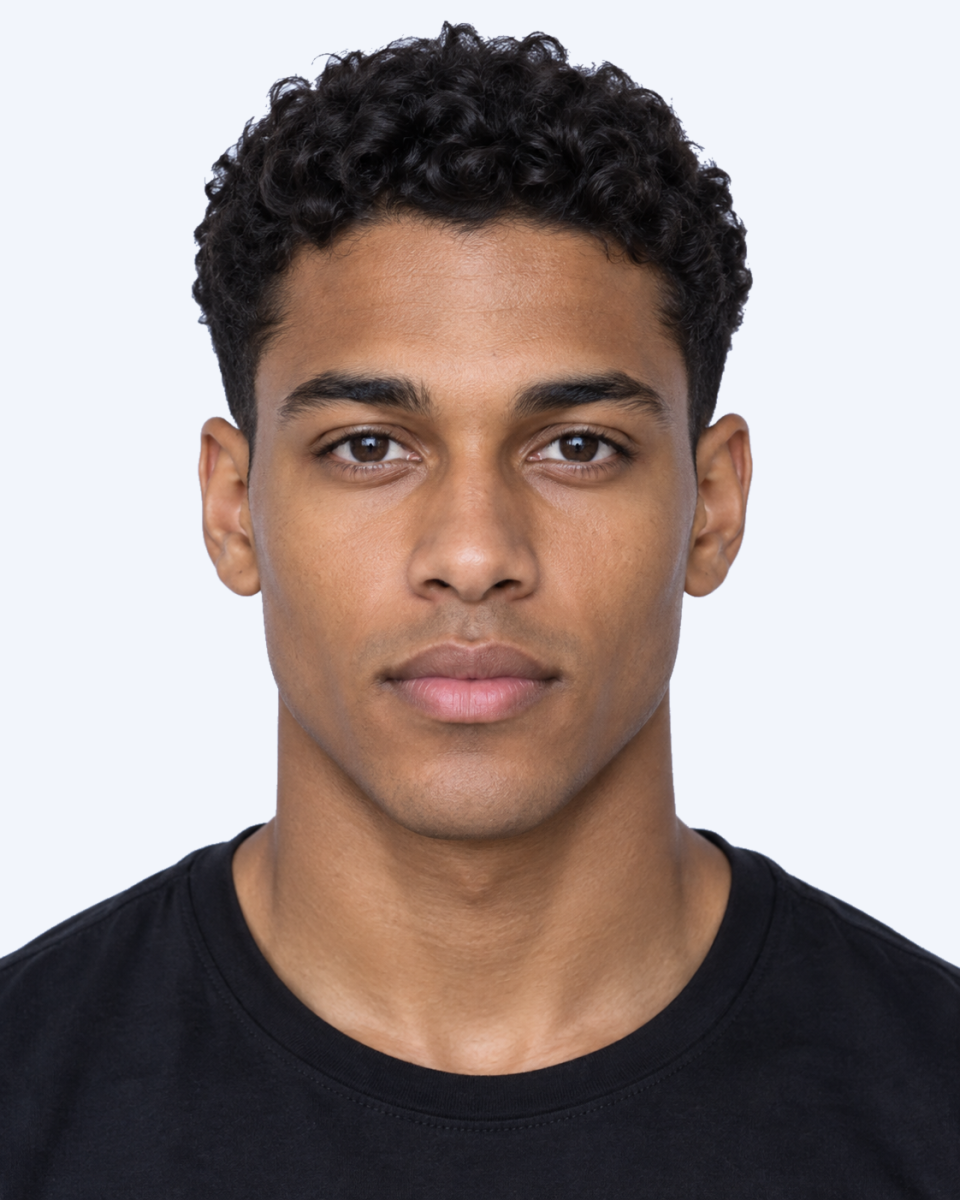
The marked points show where we measure interpupillary-to-face width ratio.
What different ratios look like
Compare the examples on either side with the original portrait in the centre.
Baseline comparison
Pupil spacing within the face
Eyes can stay the same distance apart and look closer together inside broader cheeks. More width lies beyond the eye region, making it appear concentrated towards the centre. Inside a narrower face, the same pupil span occupies more of the available width.
Pupil spacing also differs from the gap between the inner eye corners. Long openings can place the pupils far apart even when the inner gap is modest. Short eyes around a large gap can look separated locally while still occupying a small share of a broad face.
Eye size and separation
A high ratio can reflect a wide inner gap that moves the eyes apart. If eye width stays similar, the empty space around the bridge becomes a larger part of the eye region. Long eyes can also increase pupil span, but more of that span is then occupied by the openings themselves.
Narrow cheeks raise the ratio around either arrangement. If eye width relative to the face is high too, the eyes may simply occupy a large share of a narrow outline. The inner gap helps show whether their prominence comes mainly from size or separation.
A low result can likewise reflect close pupils or broad cheeks. An ordinary eye arrangement inside a broad face looks different from a small, closely grouped pair inside a narrower one. Compare the openings with each other before attributing the result entirely to spacing.
The mouth and central height beneath the eyes
The mouth provides a second horizontal span below the eyes. Widely spaced pupils can make an unchanged mouth look narrow beneath them. If the mouth is broad too, the central features may retain similar widths relative to each other while occupying more of the face.
Pupil spacing also contributes to midface ratio, where it is compared with eye-to-upper-lip height. Widening the pupils raises both ratios without shortening the face. The centre becomes wider in proportion, even though the nose and mouth remain at the same vertical positions.
A low pupil-to-face ratio alongside low relative eye width describes an eye region occupying little of the facial span. The inner gap then determines whether that region looks closely grouped or contains small eyes separated by appreciable space.
The spacing experiment
Pallett, Link and Lee altered eye and mouth placement within female faces and found preferred horizontal spacing near 46% of facial width. The eyes themselves could remain unchanged while their arrangement affected ratings.
Their facial-width measurement ran between the inner ear edges, whereas this ratio uses the cheekbones. The percentages therefore describe different spans. The 45–50% reference here places the pupils around half of cheekbone width, but the study does not directly validate those limits.
Growth of the eyes and facial outline
Eye-region dimensions and cheekbone width develop at different rates. If facial breadth grows faster than pupil spacing, the ratio falls even though the pupils may become farther apart. This can make the adult eye region look less prominent within the face than it did earlier.
Sforza's eye-region research and Fang's review of population variation describe differences in the component dimensions across samples. A typical value depends on those samples and their measurement methods. For comparisons within one person, direct gaze is important because looking to the side shifts the pupils inside otherwise unchanged openings.
How we measure it
We divide the distance between the pupil centres by cheekbone width.
- 1
Locate the centre of each pupil while looking directly at the camera.
- 2
Measure the widest span across the cheekbones.
- 3
Divide pupil spacing by cheekbone width.
Getting a clear photograph
- Use a straight-on portrait with the camera near eye height and the head upright.
- Avoid close wide-angle selfies; perspective changes central features relative to the facial outline.
- Looking away from the lens displaces both iris centres inside the eye apertures.
- Turning the head narrows the visible cheekbone span and shifts the apparent position of the pupils.
Check the marked points
- Confirm the subject looks directly into the lens.
- Check both iris centres and both cheekbone contours.
- Retake if gaze or head rotation is asymmetric.
Measure your interpupillary-to-face width ratio
Upload a front-facing photograph to see your result and review the marked points.
Sources
- 1 New “golden” ratios for facial beauty
Within-face experiments tested eye and mouth spacing. Published percentages use specific face-height and inner-ear-width endpoints, not every app ratio.
- 2 Age- and sex-related changes in the soft tissues of the orbital region
Documents age and sex differences in eye-region dimensions; orbital dimensions are not interchangeable with central eyelid-opening height.
- 3 Craniofacial growth: a three-dimensional soft-tissue study from 6 years to adulthood
Documents unequal growth of facial regions, including greater proportional growth of the lower third.
- 4 A systematic review of interethnic variability in facial dimensions
Documents population variation, particularly in forehead height, interocular distance and nasal width; it does not compare attractiveness.
- 5 Glowometry front-view measurement protocol
Explains how the measurement is calculated and which reference range is used.
- 6 Reliability of measurements taken from facial photographs
Documents the effect of photographic setup and landmark placement on facial measurements.
- 7 Focal length affects depicted shape and perception of facial images
Shows that camera focal length changes depicted facial shape, measured proportions and attractiveness ratings.
Related guides
Intercanthal-to-eye width ratio
The inner-eye gap relative to eye width: a larger gap and shorter eyes can produce the same ratio.

Eye width-to-face width ratio
Eye width relative to the cheeks, and how opening height changes the appearance of eye size.

Eye-to-mouth angle
The angle formed by the pupil centres and mouth, and how spacing changes its shape.