Total face height-to-width ratio
Total face height-to-width ratio compares the distance from the central hairline to the bottom of the chin with cheekbone width. Higher values describe a longer or narrower outline; lower values describe a shorter or broader one.
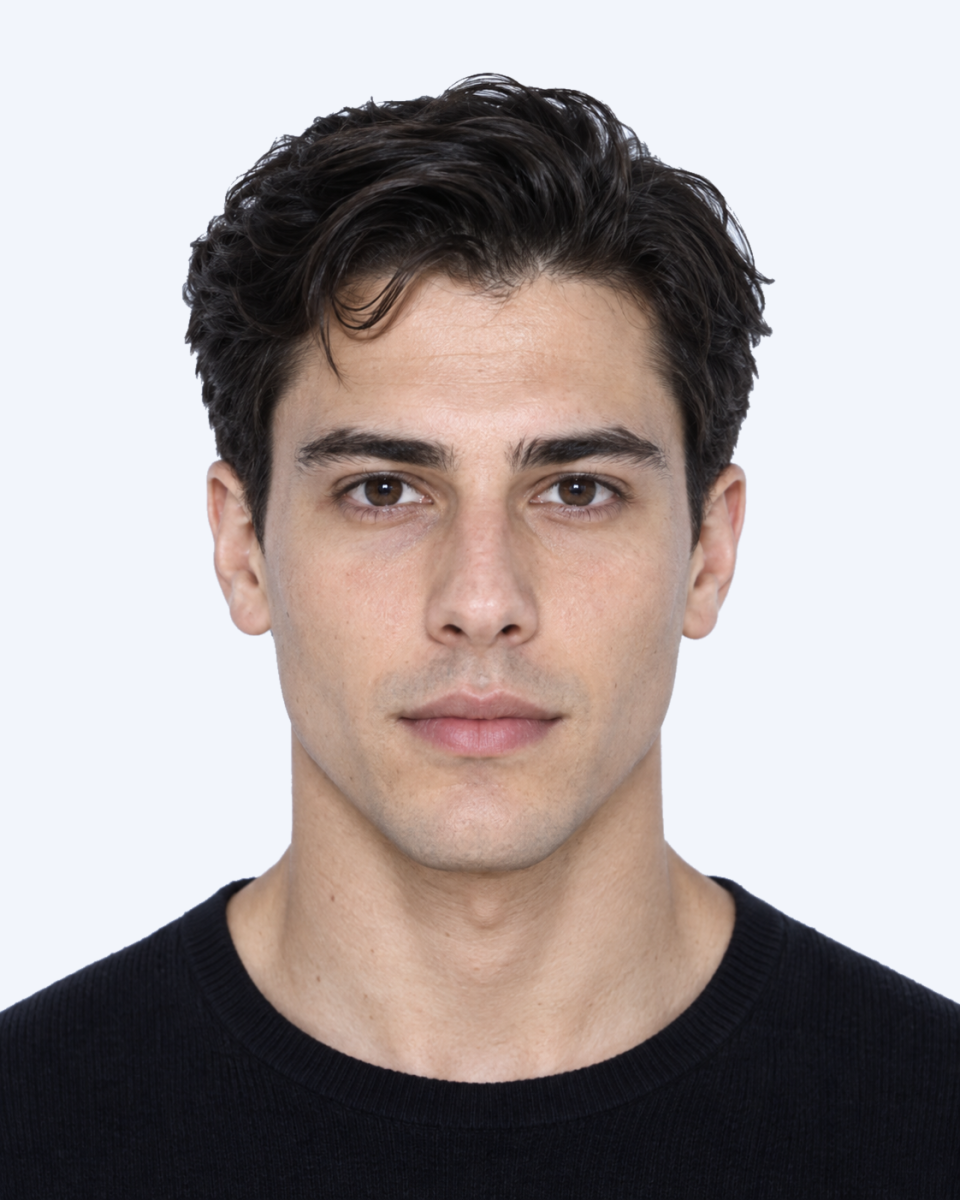
1.37 ratio
Total face height-to-width ratio
hairline-to-chin height divided by cheekbone width.
The marked points show where we measure total face height-to-width ratio.
What different ratios look like
Compare the examples on either side with the original portrait in the centre.
Baseline comparison
The overall facial outline
The outer face changes how much space surrounds the features. Widening the cheeks can make unchanged eyes and a mouth look more concentrated towards the centre. Adding height makes their vertical positions within the face more noticeable.
The overall ratio describes that broad-versus-elongated relationship, while the contour determines the particular shape. A long rectangle and a narrow oval may have similar height-to-width values but differ in how much the sides taper. Temple, jaw and chin widths show where the outline retains breadth.
Added height and reduced width
A high ratio can reflect extra height in a particular region. A tall forehead adds space above the nasal root, while a long lower face extends the region below the nose. When several regions contribute, the whole face may look elongated without one part standing out.
Narrow cheeks can also raise the ratio while the vertical distances remain ordinary. The lateral outline sits closer to the features, making the face look long by comparison. Facial thirds may remain evenly divided because narrowing changes the surrounding width rather than the distribution of height.
Extra height and limited width can occur together. The impression is stronger when the jaw and chin also narrow, while a broad lower face can retain a rectangular shape through the added height.
Broad faces and short faces
A low ratio can come from a short hairline-to-chin distance or broad cheeks. A short face brings its upper and lower boundaries closer to the central features. A broad face may retain substantial vertical space while extending farther to the sides.
The jaw determines how far that breadth continues below the cheeks. Broad corners and a broad chin can create a square or short rectangular outline. A narrow jaw beneath the same cheeks creates more taper, making the cheekbones the most prominent span.
Temple width affects the upper transition in a similar way. Broad temples make the sides straighter above the cheeks, while narrow temples add an outward curve into them.
The central face within the outline
A long face can contain a compact centre. High total height-to-width together with high fWHR suggests that the forehead or lower face contributes length outside the central interval. The eyes, nose and upper lip may occupy a relatively short region within the longer outline.
Facial thirds help locate that height. A large lower-third share still needs to be divided around the mouth: extra space above the upper lip separates it from the nose, while extra space below the lower lip extends the chin. These arrangements place the mouth at different levels within the lower face.
Compare width around the longer region too. A tall lower face with broad corners and a broad chin forms a substantial rectangular base. The same height ending in a narrow chin produces a more slender outline.
Growth, hairline and soft tissue
Ferrario and colleagues documented unequal growth across facial regions, with substantial development of the lower face towards adulthood. Velemínská and colleagues associated larger faces with greater elongation. Height and width can therefore change together without preserving the same ratio.
The hairline can change the upper endpoint independently of the regions below it. Recession at the centre increases measured height even if the nose and jaw remain unchanged. A naturally tall forehead can give a similar result, so earlier photographs are useful when discussing a change.
Soft-tissue fullness also affects visible breadth. Fuller cheeks may lower the ratio and round the outline without shortening the face. Compare the actual boundaries in similarly posed photographs to see which dimension has changed.
Facial outline and attractiveness
The facial-form experiment cited below found that changing the outline affected attractiveness ratings. Abbas and Duchaine also found that ratings of one facial region depended on the region paired with it.
The 1.28–1.38 reference describes one overall height-to-width relationship. Its endpoints are not established preference boundaries for every distribution of forehead and lower-face height. A broad, long lower face and a tall forehead above a short centre can share the ratio while presenting different outlines.
How we measure it
We measure the full height of the face, from the central hairline to the bottom of the chin, and divide it by cheekbone width.
- 1
Mark the central hairline and the lowest point of the chin.
- 2
Measure the widest part of the face across the cheekbones.
- 3
Divide hairline-to-chin height by cheekbone width.
Getting a clear photograph
- Use a straight-on portrait with the camera near eye height and the head upright.
- Avoid close wide-angle selfies; perspective changes central features relative to the facial outline.
- Keep the central hairline visible; hair over the forehead makes the starting point difficult to place.
- Looking up or down changes the visible distance from hairline to chin. Keep the head upright.
Check the marked points
- Place the hairline point at the central skin-to-hair transition, not the top of the hairstyle.
- Confirm that both cheekbone points mark the widest cheek contours.
- Retake if the chin or central hairline is cropped or obscured.
Measure your total face height-to-width ratio
Upload a front-facing photograph to see your result and review the marked points.
Sources
- 1 Craniofacial growth: a three-dimensional soft-tissue study from 6 years to adulthood
Documents unequal growth of facial regions, including greater proportional growth of the lower third.
- 2 Surface facial modelling and allometry in relation to sexual dimorphism
Relates facial size to shape and sex-related morphology in young Central European adults; larger faces were more elongated.
- 3 Analysis of Hairline and Forehead Sexual Dimorphic Aesthetics in 60 Celebrities Using Artificial Intelligence
Shows why central forehead height and lateral hairline shape need separate interpretation in a selected celebrity sample.
- 4 Facial Adiposity, Attractiveness, and Health: A Review
Explains soft-tissue breadth as a contributor to facial appearance and distinguishes perceived adiposity from a direct measure of body composition.
- 5 Effects of facial forms and midline deviations on female facial beauty
Uses 45 controlled frontal facial-form states and 15,042 observer ratings.
- 6 The role of holistic processing in judgments of facial attractiveness
Composite-face experiments show that the attractiveness of one region is influenced by the rest of an aligned face.
- 7 Glowometry front-view measurement protocol
Explains how the measurement is calculated and which reference range is used.
- 8 Reliability of measurements taken from facial photographs
Documents the effect of photographic setup and landmark placement on facial measurements.
- 9 Focal length affects depicted shape and perception of facial images
Shows that camera focal length changes depicted facial shape, measured proportions and attractiveness ratings.
Related guides
Facial width-to-height ratio (fWHR)
Cheekbone width relative to central-face height, with research on appearance and facial growth.
Facial thirds
The division of facial height between the forehead, nasal region and lower face.

Bigonial width ratio
Jaw width relative to the cheekbones, from a tapered lower face to a broader outline.